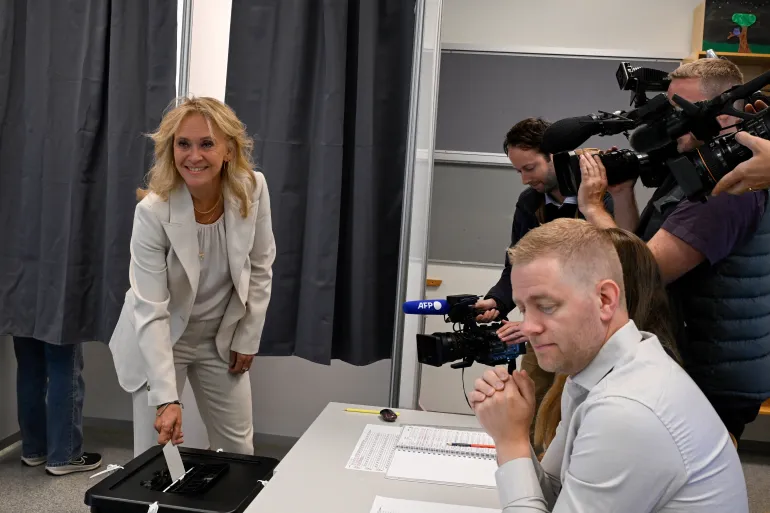
Former essayist and European parliament deputy, Raphael Glucksmann is expected to announce his bid for France’s presidential race next year, joining an already crowded field of left-wing contenders
Glucksmann, the 46 year old leader of the centre-left party, Place Publique, is expected to declare his intention during a primetime interview on TF1 television on Sunday.
His move is expected to have the immediate consequence on Glucksmann’s partner, journalist Léa Salamé, a leading figure on rival public channel France 2, who is expected to announce her withdrawal to avoid any conflict of interest during the campaign.
This could be leader of France’s far-right, Marine Le Pen’s best ever chance of winning the Élysée in 2027, but a host of candidates from the left and President Emmanuel Macron’s centrist camp, have already announced their intentions.
As at June 2026, Le Nouvel Obs counted more than twenty-five candidacies who had claimed interest or officially declared. Some of them include hard left leader Jean-Luc Melenchon, Greens leader Marine Tondelier, Socialist Party (PS) leader Olivier Faure and even possibly ex-president Francois Hollande, who reports say is considering entering the race.
Raphaël Glucksmann is polling at between 10% and 12%, according to recent surveys, which is a respectable position, though still well short of the threshold likely to be needed to reach the second round of France’s 2027 presidential election.
His strongest argument is his performance in the 2024 European elections. Glucksmann led the joint Socialist Party, Place publique, to 13.8% of the vote, emerging as the strongest figure on the French left and giving him a platform for a potential presidential bid.
The challenge is preventing the left-wing vote from splintering. The Socialist Party and Place publique are preparing to hold a primary in October to select a single candidate. The rules are expected to be finalised in the coming days and formally approved by both parties next Tuesday.
Socialist members rejected an open primary proposed by party leader Olivier Faure in a vote in July. Instead, they backed a closed contest limited to members of the Socialist Party, Place publique and a proposed broader “social-democratic pole.”
That narrower electorate could work in Glucksmann’s favour. But he also has a practical reason to stay close to the Socialists. While his politics are more reformist and centrist than those of the traditional left, he lacks the party infrastructure needed for a nationwide presidential campaign.
An alliance with the Socialist Party would give him access to its activists, local networks and electoral machinery, which could prove crucial if he decides to make his bid for the Élysée Palace.