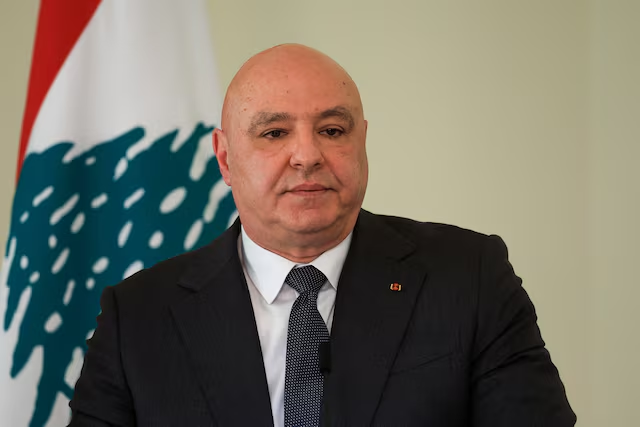
Lebanese President Joseph Aoun has appealed to the United States and the international community to intervene after Israeli strikes killed at least seven people in southern Lebanon.
Aoun described the attacks as a “dangerous escalation” and accused Israel of striking Lebanese state institutions and health facilities.
The Lebanese Health Ministry initially reported four deaths on Sunday. It later reported three more deaths from a separate Israeli drone strike in Nabatieh al-Tahta.
The latest strikes have further strained a US-brokered cessation-of-hostilities arrangement between Israel and Hezbollah.
Strikes hit southern Lebanon
Israeli aircraft struck several locations in and around Nabatieh in southern Lebanon on Sunday.
The strikes killed two men in a town near the Israeli-occupied security zone, according to the Health Ministry. Two women also died in Arab Salim, north of the occupied area.
A separate drone strike on Nabatieh al-Tahta later killed three people.
Six others suffered injuries in the Arab Salim strike, including two girls, according to the Health Ministry.
The attacks also damaged Lebanon’s Finance Ministry building and destroyed the Ghandour Hospital in Nabatieh, Lebanese officials said.
Aoun said the strikes went beyond alleged attacks on Hezbollah targets and reached civilian institutions.
He called on the US and other countries to act urgently to stop what he described as repeated violations.
Israel says it targeted Hezbollah
The Israeli military said its strikes followed a Hezbollah drone attack on Israeli troops near a strategic ridge in southern Lebanon.
Israel said it targeted Hezbollah operatives, weapons storage sites and a command centre inside a building formerly used as a hospital.
The military said it used precision weapons and aerial surveillance to reduce civilian casualties.
Hezbollah has not claimed responsibility for the drone attack cited by Israel, according to Reuters.
Israel has maintained forces inside what it calls a security zone in southern Lebanon despite the cessation-of-hostilities arrangement reached in June.
The Israeli military has also issued evacuation warnings ahead of some recent strikes. Sunday’s warning covered an area near the building in Arab Salim that Israel said it planned to attack.
US-backed ceasefire faces new pressure
The latest violence comes as Lebanon and Israel pursue direct talks under US supervision.
Hezbollah opposes those negotiations.
The group has accused Israel of using continued military pressure to influence the Lebanese government during the talks.
The escalation has also raised concerns over the ability of Lebanon’s government to implement its commitments in the south.
Aoun has sought to strengthen state authority while pressing for an end to Israeli military operations.
His appeal to the US puts further pressure on the administration to use its role as mediator to contain the violence.
Strikes follow earlier deaths
The latest attacks came two days after Israeli strikes killed four people and injured 23 across southern Lebanon, according to Lebanese authorities.
Israel said those strikes targeted Hezbollah weapons storage facilities.
The repeated attacks have increased tensions around the US-backed cessation-of-hostilities framework.
Lebanese officials say continued Israeli operations undermine the country’s sovereignty and state institutions.
Aoun has now urged the US and the wider international community to act before the latest escalation develops into a broader confrontation.