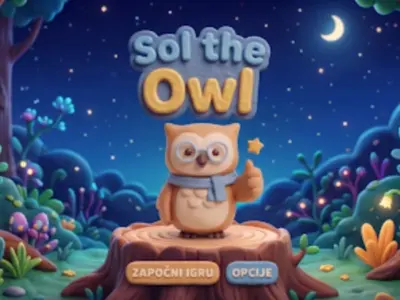
A virtual assistant called Sol the Owl guides kids through the game
Originally published on Global Voices
SafeClick is a video game that teaches children with Down syndrome about digital safety. A virtual assistant, Sol the Owl, that guides them through the game. Image by the game's developers, used with permission.
This interview is part of a series of spotlights on the work of some of the grantees of the Digital Spark granting scheme, as part of the Regional Support Mechanism EECA project, implemented by the Metamorphosis Foundation and TechSoup, in partnership with CIVICUS and under the Digital Democracy Initiative (DDI) that covers the Global South. It is being published on Global Voices as part of a content-sharing agreement.
Like their peers, children and young people with Down syndrome are curious about technology and the internet, but there are often no suitable, dedicated tools to help them learn how to safely navigate the web. This is true in Bosnia and Herzegovina as well, where children with cognitive disabilities are underserved and tend to end up in digital isolation because of caregivers’ concerns about digital safety and the risks of being online.
There are approximately 550-700 children and adolescents with Down syndrome in the country. They are supported by three specialized associations nationwide: the Association “Life with Down Syndrome of FBiH”, Down Syndrome Association Mostar, and DOWN SY I MI. To teach online safety, these organizations have to rely on online safety tools that heavily feature text, abstract explanations, and complex language, which are not accessible or meaningful for children with Down syndrome.

Stefan Filipovic. Photo used with permission.
A group of developers, IT professionals, and designers in Bosnia and Herzegovina has been working to address the lack of a digital safety tool tailored to children and adolescents with Down syndrome. Their goal is to help young people understand, practice, and feel confident making decisions online.
Global Voices conducted a written interview over email with Stefan Filipovic, a member of this group, to learn how they created a video game to teach children with the genetic condition about digital safety. The interview has been edited for clarity and brevity.
Global Voices (GV): Please tell us about your organization and why you chose to get involved with the Digital Sparks project.
Stefan Filipovic (SF): We are a group of IT professionals, developers, and designers from Bosnia and Herzegovina. Most of our work is in commercial technology, but we also have experience developing educational and socially useful video games, such as Eureka – Edukativna videoigra, an educational game for children, and Lea & Leo, a game about children with diabetes.
We joined the Digital Sparks project because we wanted to use that experience for a group that, in our opinion, is often overlooked when digital products are designed. Young people with intellectual disabilities are using phones and the internet, but many digital tools are simply not designed with their needs in mind.
The video game SafeClick (Siguran klik) allowed us to work on something practical and useful while also learning how to design more inclusively and to involve educators and users in the process.
GV: What issue/challenge in your community prompted you to undertake this project?
SF: While working with Servis Centar “Dajte nam šansu – Zvjezdice” – an association and day center that provides free support to children, young people, and people with developmental disabilities, we saw that young people with Down syndrome were using phones and the internet, but there were very few cyber-safety resources made specifically for them.
Most materials use a lot of text, complicated explanations, or interfaces that are difficult to follow. To our knowledge, parents and educators often end up focusing on limiting internet use rather than teaching young people how to deal with unsafe situations.
We wanted to try something different. With SafeClick, we use simple stories, familiar situations, pictures, and game mechanics to help users practice what to do when they receive a suspicious message, meet someone online, or experience cyberbullying.
GV: What are the key changes/activities that your organization implemented during your participation in the project?
SF: We developed the first playable version of SafeClick. The game is currently awaiting approval by the App Store and Google Play. It is designed for mobile devices, with simple, accessible interactions and visual scenarios.
One important decision was to avoid punishing users for mistakes. Instead, the game explains what happened and gives them another chance. We worked closely with educators and parents and used their feedback to make the scenarios easier to understand.
We are currently in the phase of arranging mentoring sessions with the mentor assigned to us through the project, with the aim of earning additional opportunities to promote the game and reach as many users as possible.
GV: How did your participation in the project impact your organization’s beneficiaries and the community that you serve? Please provide examples.
SF: Although the game will be published soon, the initial feedback from special education teachers and parents has been highly practical. Special thanks to Jelena Zilic and her children, who provided the first useful in-game test users’ feedback. They helped us see that situations, which are difficult to explain verbally, can become much easier when they are shown visually and practiced through a game.
For example, instead of simply telling someone not to respond to a stranger online, SafeClick lets them see the message, decide what to do, and practice blocking and reporting that individual, and reporting the situation to a caregiver. I really believe we managed to turn an abstract topic into something young people can actually practice.
GV: How has your own knowledge, awareness, and experience with digital democracy and civic space changed?
SF: Before this project, we mostly thought about accessibility as a product and UX (interface) issue. Working on SafeClick made us look at it differently. Being able to use the internet safely is also about being able to participate in everyday life. Communicate, learn, find information, and be part of your community.
If a person cannot understand or safely use digital services, they are left out. We also learned that privacy and accessibility should not be things added at the end of development. They need to be considered from the beginning. That is something we will take with us into our future projects.
GV: What are the most valuable lessons and experiences you are taking away from this project?
SF: The biggest lesson for us was that making something technically simple is actually quite difficult. With commercial products, it is easy to keep adding features. With SafeClick, we had to constantly ask ourselves whether a button, animation, sentence, or screen was really necessary.
Our earlier experience with Eureka – Edukativna igra and Lea & Leo helped us understand the value of video games for learning, but SafeClick taught us much more about cognitive accessibility and designing with educators and users in mind.
GV: What comes next? How will you apply the learning and digital capacity you have built in your future work and within your community?
SF: Our immediate objective is to publish SafeClick, launch it in the media, and inform the wider community about the game’s availability. Looking ahead, we plan to build on this experience to develop a wider portfolio of digital tools tailored for marginalized groups and to continue exploring how games and other digital tools can make learning and participation easier for people who are often left out of mainstream technology. We are open to new collaborations and partnerships.