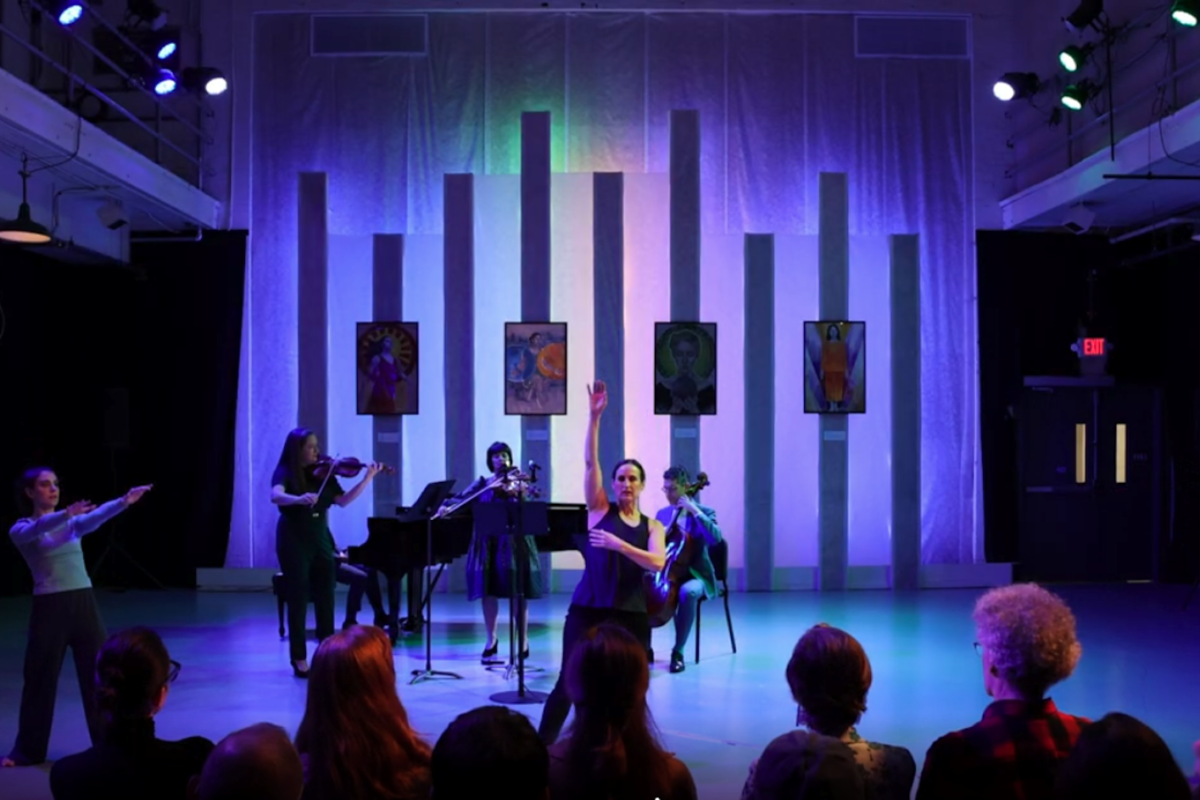
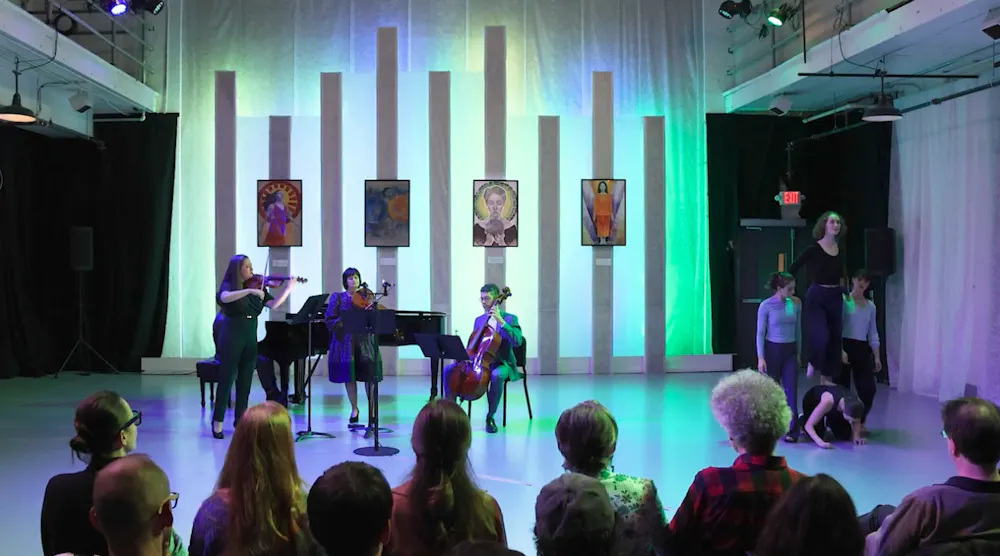
It turns out you can rent a Steinway piano and have it delivered pretty much anywhere – including the lecture hall of a major working hospital.
In October 2025, I had one delivered to UPMC Magee-Womens Hospital in Pittsburgh for the premiere of “One in Four, One in Eight,” a 60-minute piece I composed about infertility and pregnancy loss, told through music, art, dance and narration.
Every October, families across the U.S. mark Pregnancy and Infant Loss Awareness Month, first proclaimed in 1988. This year, the observance arrives as federal funding cuts threaten reproductive health research, linked page not found according to a report from the American Society for Reproductive Medicine. That matters because so much about why pregnancies end, or never begin, is still unknown.
“One in Four, One in Eight” is built around a piano quartet – piano, violin, viola and cello – with artwork and choreography woven in. The music creates a space to explore something deeply personal and physical that is often invisible from the outside and stigmatized. The project brings together the human and emotional sides of infertility and pregnancy loss with the procedural and scientific ones.
The piece takes its title from two statistics: 1 in 4 known pregnancies ends in loss in the U.S., and 1 in 8 women needs medical intervention to become and stay pregnant.
Katherine Pukinskis
I am 1 in 4. I am 1 in 8. I’ve experienced the physical, emotional, social, financial, professional and psychological costs of infertility and pregnancy loss. As an assistant music professor and composer of contemporary classical music, I draw heavily on my own experiences as sources of inspiration; my creative practice is my research. But I also often consult external sources to inform aspects of my creative work.
Four movements, four stages
The piece has four movements, each tied to a stage or experience common in infertility or pregnancy loss. Before each one, a narrator lays out the scientific context of these deeply personal experiences.
The narrations drew on interviews with Dr. Gabriela Gosman, Dr. Pamela Parker, Dr. Allison Serra and physician assistant Carrie Weaver, all reproductive care providers at UPMC Magee-Womens Hospital. They also drew on research from the American Society for Reproductive Medicine, the National Institutes of Health, the U.S. Centers for Disease Control and Prevention and the World Health Organization. Gosman reviewed and approved every narration for medical accuracy.
The first movement, “Antecedent,” is about anticipation and potential energy. Its narration presents pregnancy as a societal ideal, while noting that a live birth depends on a monthslong chain of events going just right. The music is bright and open-ended, invoking the best-case scenario. Even when it stalls, nothing is fully lost – listeners can still find a beat and tap along.
The second movement, “Fissure to Flow,” explores the friction between the body’s natural cycles and assisted reproductive technologies, or ART, which suppress and override those cycles. Pregnancy usually runs on its own clock, taking about 40 weeks from conception to birth. With ART, simply reaching a confirmed pregnancy can take months. Each round of in vitro fertilization, or IVF, is timed to a menstrual cycle, and doctors sometimes stop a round partway through, such as when the ovaries don’t respond as expected to medication. Up to 20% of rounds are stopped before eggs are ever retrieved, which means more waiting and starting over. Some people succeed after one round of IVF; others after several. Some never do.
Musically, in this movement, the four instruments playing gradually line up until they suddenly lock in, revealing how unsettled everything sounded before.
The third movement, “Somatic Drift,” is about loss and being lost. The music feels both aimless and intensely focused.
Pregnancy loss can stem from chromosomal or structural abnormalities, such as a uterine septum, fibroids or scar tissue. It can also stem from hormone imbalances involving prolactin or progesterone.
Yet about half of all pregnancy losses are unexplained. That’s not because there is no cause, but limited research and funding leave doctors with few tools to find one.
The final movement, “Fortified,” is about the calm that comes with information, though this doesn’t make it a happy ending. Its grounded music acknowledges the financial, physical, emotional and professional costs of infertility and pregnancy loss. The narration highlights changes in care I hope to see, from better pain management for invasive procedures to in-office childcare for last-minute appointments, along with new research and legislation to support ART.
To be fortified is to be made stronger. Bodies hold on to pregnancy, too. Cells from a pregnancy can remain in a person’s body for years afterward, whether the pregnancy lasted four days or 40 weeks. This is a phenomenon called fetal microchimerism.
Beyond the concert hall
“One in Four, One in Eight” was designed to reach beyond a typical concert audience. Alongside the music and the narrated science, the performances featured the San Antonio-based chamber ensemble Agarita Chamber Players, who performed the piece, along with choreography by Pittsburgh-based Attack Theatre and new visual art works by Pittsburgh visual artist Morgan Overton. Both Attack Theatre and Overton created their work in response to the music, and it debuted live during the performances.
To make the concerts easier to attend, tickets and on-site childcare were free, and the project paid for parking. Before each concert, the project team hosted talks with me and the other artists to welcome people into the conversation. Afterward, receptions gave nonprofit community organizations space to share information and resources.
The science and music in “One in Four, One in Eight” depend on one another. Where a clinical setting is a crucial component of health and healing, public performances create spaces for learning, understanding and catharsis.
Read more of our stories about Pittsburgh and Pennsylvania.

For this project, Katherine Pukinskis received funding from the MAP Fund, the Center for the Arts and Society at Carnegie Mellon University, UPMC Magee-Womens Research Institute and Foundation, the Jewish Fertility Foundation, the School of Music at Carnegie Mellon University, and the College of Fine Arts at Carnegie Mellon University