Kim Jong-un has spent years building North Korea’s nuclear force around missiles and land-based launchers. The country’s latest naval move shows that he now wants the sea to play a larger role in that deterrent.
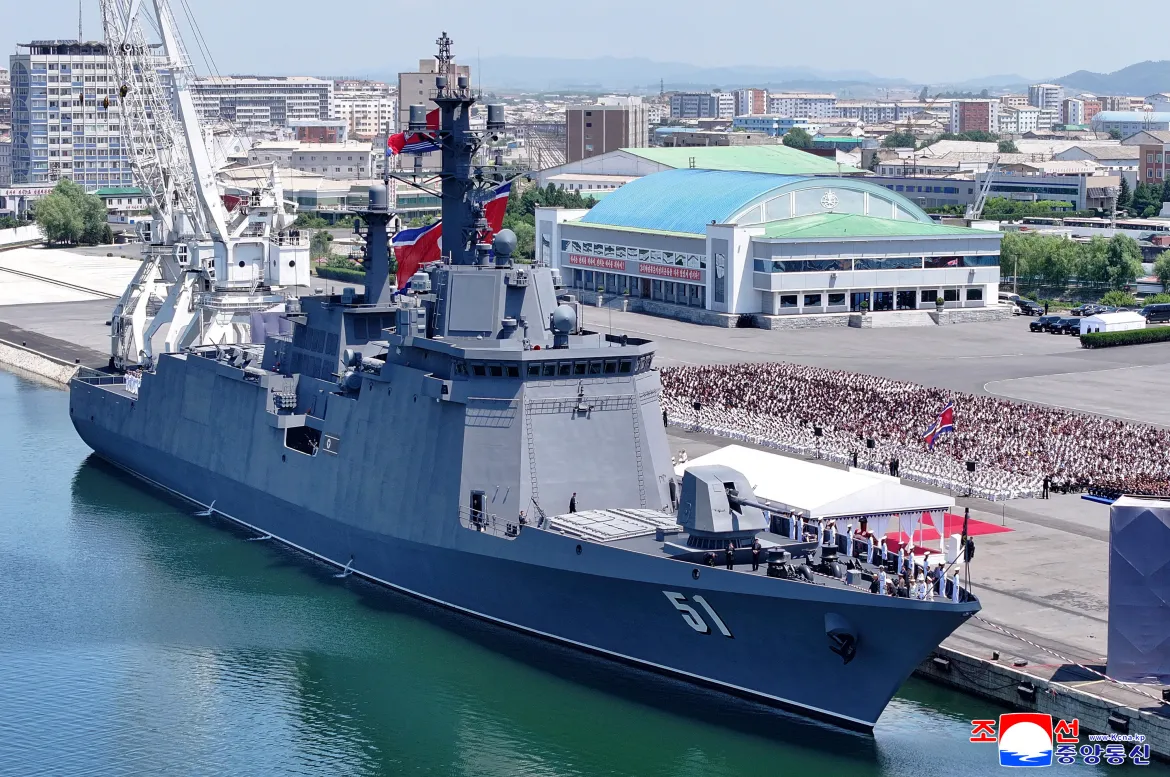
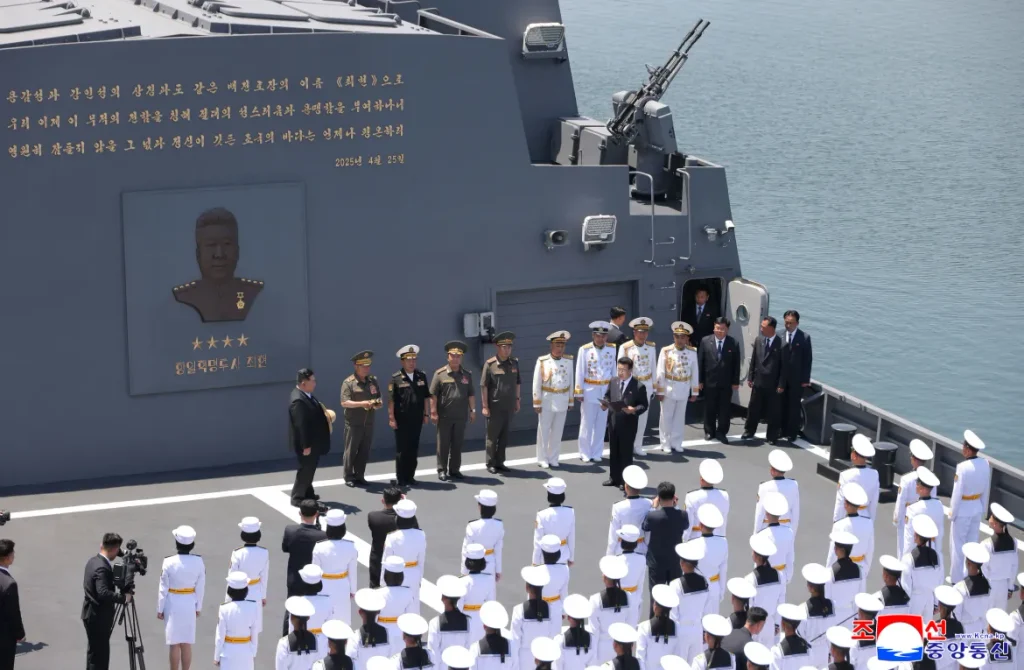
North Korea commissioned its second 5,000-tonne modern destroyer, the Kang Kon, at the eastern port of Wonsan on Sunday. Kim used the ceremony to outline a broader naval strategy, describing the ship as part of the country’s “state nuclear counteraction system” and calling for the navy to become a nuclear-armed force.
He also gave an unusually specific timetable for what comes next. Kim said North Korea was implementing an important plan to strengthen its naval forces and would demonstrate the results to the world within eight months. He offered no details, leaving analysts to assess what kind of weapon or platform could appear next.
The most consequential possibility is a nuclear-powered submarine. North Korea has pursued such a vessel for years and released images in December 2025 showing Kim inspecting the hull of what state media described as an 8,700-tonne nuclear-propelled submarine under development. Yonhap reported that the submarine project could be linked to Kim’s eight-month timetable, although Pyongyang has not confirmed that connection.
The broader significance lies in the direction of North Korea’s military strategy. Kim is no longer presenting naval modernisation as a conventional effort to strengthen a relatively weak fleet. He is increasingly placing surface ships, submarines and naval infrastructure inside the country’s nuclear deterrence structure.
A more mobile nuclear deterrent
The Kang Kon is the second destroyer of its class to enter service, following the Choe Hyon, which North Korea commissioned roughly three months earlier. The two ships give the navy modern large surface combatants on opposite sides of the peninsula. North Korea has also said it is developing additional warships and naval bases.
Kim has not said that the Kang Kon carries nuclear warheads. North Korean state media has instead described the ship as part of the nuclear response system, while outside analysts have assessed that its weapons could include nuclear-capable missiles. That distinction is important because the commissioning of the ship does not, by itself, demonstrate that North Korea has deployed a fully operational sea-based nuclear weapon.
The strategic logic is nevertheless clear. A nuclear force based largely on fixed missile facilities presents an adversary with a relatively identifiable set of targets. Ships can move between operating areas, while submarines could eventually provide an even harder-to-track platform for nuclear weapons.
Lim Eul-chul, a professor at Kyungnam University’s Institute for Far Eastern Studies, described Kim’s remarks as a public declaration that the destroyers would support sea-based nuclear deterrence. He said the Kang Kon’s deployment to waters east of the Korean Peninsula appears intended to deter US, South Korean and Japanese naval operations.
That does not mean North Korea has already achieved the capability Kim is describing. Its nuclear-powered submarine programme remains under development, and questions remain over the maturity of its naval weapons, sensors and ability to sustain operations far from its coast. The significance of the Kang Kon is therefore less about what the ship can prove today than what its commissioning says about the capabilities Pyongyang is trying to build.
Why the eastern waters matter
The Kang Kon will serve with North Korea’s East Sea Fleet, giving the deployment a clear geographic dimension. The decision comes as the United States, South Korea and Japan begin the five-day Freedom Edge exercise around waters near South Korea’s Jeju Island, with the three countries seeking to strengthen their response to North Korean nuclear and missile threats.
Kim has repeatedly portrayed US military deployments and allied exercises around the Korean Peninsula as evidence of an external threat. His speech at Wonsan followed that familiar argument, but this time he paired it with a concrete expansion of naval capabilities.
He said North Korea needed to exercise its sovereignty “at sea and underwater” and presented the eastern deployment as a signal to its adversaries. The message extends beyond the immediate commissioning of one destroyer. Pyongyang wants to place more capable weapons closer to waters where US, South Korean and Japanese naval forces operate.
That could eventually support an anti-access strategy designed to make allied naval operations more complicated and costly. A fleet with longer-range missiles, improved sensors and eventually submarines could threaten ships operating around the peninsula without requiring North Korea to rely exclusively on land-based systems.
The approach also fits Kim’s broader effort to diversify the country’s nuclear deterrent. North Korea has developed ballistic missiles of different ranges, tactical nuclear weapons and cruise missiles. Adding naval platforms would create another layer of uncertainty for South Korea, the United States and Japan because they would have to account for weapons that could operate from changing positions at sea.
The eight-month deadline makes the next stage particularly important. Another destroyer would demonstrate that North Korea can continue producing large surface warships, but a significant advance in its submarine programme would carry much greater strategic weight.
A nuclear-powered submarine could remain at sea for longer periods and operate farther from North Korean waters than a conventional surface vessel. If Pyongyang eventually combines that platform with a reliable submarine-launched nuclear weapon, it would give North Korea another potential leg in its nuclear deterrent.
That remains a future capability rather than an established one. For now, the evidence points to a country moving deliberately towards a more diversified maritime force, with Kim linking that expansion directly to nuclear deterrence.
The Kang Kon therefore matters as part of a larger transformation. North Korea is building bigger warships, expanding naval infrastructure and assigning strategic roles to vessels that previously would have served mainly conventional purposes.
Kim’s eight-month promise suggests that the destroyer is not the endpoint. Whatever North Korea unveils next, the direction is increasingly clear: Pyongyang wants its nuclear deterrent to operate not only from land, but also across the waters surrounding the Korean Peninsula.