Young activists are reshaping protest into something accessible, individual, and nonhierarchical
Originally published on Global Voices
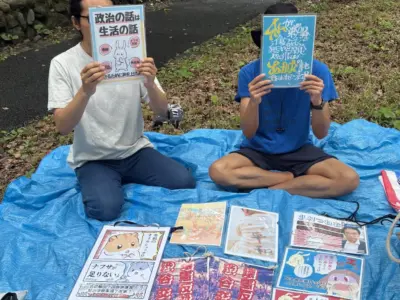
Tattsu’s “Hibiya Kōen Lunch Protest.“ Every Monday and Friday, he spreads out placards about government policies, from health care to peace issues, on a blue tarp in Hibiya Park during lunch hours, inviting people to sit and discuss with him over lunch. Photo taken by Jo Carter. Used with permission.
This post is part of Global Voices’ September 2026 Spotlight series, “Protest in Democracy.” With this Spotlight, we seek to explore the many forms of protest, the tactics states use to delegitimize and suppress them, and the complex relationship between protest and democracy. You can support this coverage by donating here.
August 15, 2026, marks the 81st anniversary of the end of World War II — a date when Allied nations celebrated victory over the Axis powers, including Japan. The date triggers a complex collective emotion in Japan: For some Japanese, it is a moment for deep reflection over the country’s history of wartime violence. For others, the anniversary dredges up feelings of remorse, pain, or humiliation, as the war and the atomic bomb that ended it, took hundreds of thousands of their countrymen’s lives.
This year, the anniversary landed amid Japanese Prime Minister Sanae Takaichi’s push, as part of her broader right-leaning agenda, to amend the country’s pacifist postwar constitution, stepping away from a strictly pacifist framework.
Meanwhile, Japanese peace activists commemorated the date with a variety of events and rallies. Attending several of these gatherings, Global Voices observed Japanese peace activism shifting from a more ideological, often confrontational and hierarchical approach among the older generation to a more individualized, accessible, pop-culture-centered approach among young people.
The academic left
The first event was a leftist symposium, “The 81st Year of the Post-War Era: A Dialogue to Halt the Collapse of Democracy,” organized by Civic Cultural Forum on August 15 at the Japan Education Center, a few miles away from Yasukuni Shrine — a controversial site which has been criticized by China, Korea, and even Japan’s own left-wingers for including more than 1,000 convicted WWII war criminals’ names in its “Book of Souls,” an honored list of people who have devoted their lives to Japanese society.
Three professors from The University of Tokyo opened the discussion with their critical perspectives on the current civil society crisis in Japan.
Among them, Professor Tetsuya Takahashi, who is a known critic of Japanese nationalism, pointed out that the Japan-U.S. security treaty signed in 1951, which grants the U.S. military forces access to its land, air, and sea for mutual defence purposes, had led to the “colonization” of Okinawa, as much of the island was handed over to the U.S. military, while Indigenous people there were stripped of their lands and rights.
Takahashi criticized the mainland liberal left for failing Okinawans, as they did not challenge the structural discrimination against minority citizens.

The 81st Year of the Post-War Era: A Dialogue to Halt the Collapse of Democracy. Photo taken by Jo Carter. Used with permission.
The 156-seat venue was packed, with some standing through the whole three and a half hour gathering. The vast majority of attendees were well-educated retirees in their 60s and older, comfortable with academic discussions on complex issues such as geopolitics and post-war political theory.
Some participants expressed concern about the very few young faces in the room. Sociologist Yuki Honda explained this by noting that the younger generation was overwhelmed by despair of an unjust society:
今の若い人たちは将来への不安から権威主義的になっています。自分が生き残ることに必死なあまり、強者におもねり、弱者を叩くようになってしまっています。
Despair is driving young people to authoritarianism. These days, they are desperate to survive and often end up trying to suck up to the powerful and punch down on the vulnerable.
Stressed street protests
On the same day, numerous protests took place near Yasukuni Shrine, including one from conservative groups advocating for “reverence for the heroic spirits of the war dead,” and another by anti-war left-wing groups calling for “the pledge of non-war and peace.”
An Okinawan activist, Takamatsu Gushiken, known as the “bone hunter,” because he has spent nearly 40 years searching caves in southern Okinawa for the remains of soldiers from the Battle of Okinawa, held a symbolic hunger strike to protest the government’s plan to relocate U.S. Marine Corps Air Station Futenma to a new location in Henoko, which would require mass land reclamation using sand from southern Okinawa. Many remains have yet to be excavated from Southern Okinawa, and Gushiken argues that the project is disrespectful to the dead on both sides of the battle.
During the Battle of Okinawa (April 1–June 22, 1945), at least 149,425 Okinawan people were killed or forced into suicide upon defeat, with their remains yet to be recovered. Gushiken launched his first hunger strike in 2021, when the relocation plan was made public.

Takamatsu Gushiken. Photo taken by Jo Carter. Used with permission.
On the eve of the anniversary of the end of WWII on August 14, Gushiken expressed worries at the event “A Talk by Takamatsu Gushiken: No More Battle of Okinawa, No More War” about the Prime Minister’s remarks on Taiwan and its implications for Okinawa:
私たちは戦争が起きたら死ねと言われているんです。[…]台湾有事が起きたら沖縄本島は屋内避難せよと言われています。人口が多いから避難させられないということです
We are basically told to die if war breaks out. […] If a Taiwan contingency happens, the large population on Okinawa’s main island makes it impossible for us to evacuate outside the prefecture.
Highlighting U.S. Secretary of Defense Pete Hegseth’s statement in March 2025, that “Japan would be on the front lines of any contingency we might face in the western Pacific,” he appealed to the young generation to see the war in terms of human lives rather than geopolitical interests.
On August 15, as Gushiken approached the Yasukuni Shrine, a right-winger blocked his way and shoved him and his team down to the small corner of the slope.
In the afternoon, another confrontation took place as 50 activists from Hantenren (the Anti-Emperor Association) held their annual protest near the Shrine; a group of right-wing protesters attacked them while shouting discriminatory slurs such as “Korean, go back to your country!” and “you old hag.” Eventually, police officers had to move in to separate the two groups.

Japanese police officers stepped in as right-wing protesters approached anti-war activists. Photo taken by Jo Carter. Used with permission.
Young people forging thier own path to peace
Many young Japanese find academic talks and street conflicts unappealing and far removed from conventional activism. However, that doesn’t mean they don’t care about politics and peace issues.
Young activist Tattsu (@kizuki11674), for example, created his own strategy to make political action more accessible. Every Monday and Friday, he spreads out placards about government policies, from health care to peace issues, on a blue tarp in Hibiya Park during lunch hours, inviting people to sit and discuss with him over lunch. The park is highly symbolic and considered Japan’s first people’s park, as it hosted the first large-scale social protest in 1905 to challenge the imperial state. Tattsu brands his activism “Hibiya Kōen Lunch Protest” — a way to transform intense political debate into a calm, friendly conversation.
On August 13, Tattu explained the rationale behind his action to GV:
街頭演説やスタンディングは、常に嫌がらせや理不尽な質問に晒されます。特に政権に反対するとき、反対派は「じゃあ代替案を出せ」と要求してきます。これが、人々がデモに参加するハードルを上げています。
Street speeches or standing on the sidewalk always expose us to harassment and absurd questions. In particular when one challenges the government, opponents often look for debate: ‘So, what's your alternative?’ This raises the hurdle for people to join protests.
He believed that ordinary people should be involved in political deliberation regardless of their knowledge. Rather than directly criticizing the government, Tattsu’s placards adopt manga-style or pop aesthetics, and their messages appeal to individual choices and their effects, such as:
私が戦争で傷ついて欲しく無いと願う人々の中にはあなたの事も含まれています
I wish the people I care about wouldn’t be hurt in war, and that wish includes you.
黙っていればそのまま。声を上げれば社会は動く。
Staying silent changes nothing. Raise your voice and society moves.
This shift toward individual autonomy over party-driven dogma was emphasized by a Park Lunch Protest participant Yuichi Nakata, who became a peace activist in 2015 when the Abe administration passed the peace and security legislation:
ネットの普及によりデモ活動は政治家の手を離れましたが、ネットでの連帯だけでなく、人と人との対面での対話が必要です。
With the spread of the internet, demonstrations moved beyond the politicians’ control. Beyond online solidarity, face-to-face dialogue among citizens is now necessary.

August 15 anti-war rally at downtown Shinjuku South Gate. Photo taken by Jo Carter Used with permission.
Tattu is not alone; young activists are reshaping protests into something accessible, individual, and nonhierarchical. This trend of people valuing participation of their own free will was also evident at the August 15 anti-war rally at downtown Shinjuku South Gate. The event drew participants of all ages and genders, with participants sporting idol penlights and brightly colored, pop-style placards borrowed from popular fandom culture.

Photo taken by Jo Carter. Used with permission.
One participant wore a protest sign that read, “General Citizen: I have no affiliation with any political party.” Indeed, unlike conventional political gatherings, about 100 people stood in a circle, passing a microphone in an open, free-speech format. The messages, mostly from younger speakers, leaned on gut-level appeals: “I just want to keep enjoying violent action movies in peace — so, no war.” “I have two high schoolers. I’m not sending them to the battlefield. Don’t kill children! Don’t kill adults! Don’t kill anybody!”
The atmosphere was relaxed and encouraging; many spoke up against politicians’ view that nukes are a crucial deterrent in navigating current global tensions.
Watching this open-mic circle, a veteran participant who had attended the afternoon’s academic symposium marvelled with tears in her eyes,
かつてのデモは、労働組合が作ったプラカードをかかげて、指示されたスローガンを復唱するだけでした。でも今は、ここにたくさんの若い人がいて、みんなが自分の言葉で話している。本当に素晴らしいことです。
In the past, protests were just about holding union-made placards and chanting union-made slogans. But now, there are so many young people here…seeing everyone speak in their own words here is wonderful.