Rural women in Kazakhstan work 10 to 15 hours per day, most of it uncounted and unpaid
Originally published on Global Voices
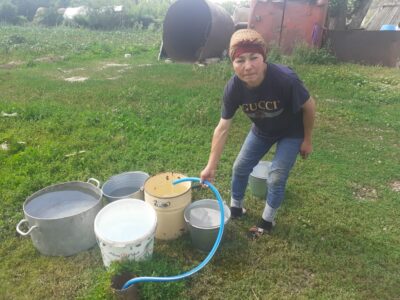
Ajgul Serikova, a resident of Uzunkol district of Kostanai region in northern Kazakhstan, collects as much water as she can before the taps run dry. Image via Central Asian Bureau for Analytical Reporting (CABAR.asia). Fair use.
This article was produced by Nazgul Aidabossynova from Kazakhstan through the Digital Spark granting scheme, as part of the Regional Support Mechanism EECA project, implemented by the Metamorphosis Foundation and TechSoup, in partnership with CIVICUS and under the Digital Democracy Initiative (DDI) that covers the Global South. It is being published on Global Voices as part of a content-sharing agreement.
In the village of Qyzylsay, southern Kazakhstan, the water disappears every afternoon. This is not a metaphor. By noon, the pipes literally go dry.
Women wake before dawn to fill every container they own. Then they wait for the water to return. And while they wait, they carry buckets to gardens, feed livestock, take children to school, and shoulder an invisible mountain of labor that nobody counts, nobody pays for, and nobody sees. Ten women decided to change that.
The problem nobody counted
Qyzylsay sits in one of the hottest corners of Kazakhstan. Summers here now break records that old-timers say didn’t exist 20 years ago. According to Kazakhstan’s own data, water losses reach 40–60 percent in rural areas. Many rural areas also lack adequate sanitation infrastructure, according to research from The Borgen Project, so even when there is water, it isn’t always safe to drink. For the women of Qyzylsay, this is not a statistic. It is the silence of an empty tap at midday.
In June 2026, UN Women released its landmark report “Progress of the World’s Women 2026: Gender Equality in the Age of Climate Crisis.” It stated plainly what women in Qyzylsay already knew in their bones. You cannot build sustainable agriculture, or any sustainable future, without integrating the “care economy” into climate and agricultural planning.
Rural women bear the heaviest burden of energy shortages, physical labor, and livestock care. The result is that they have almost no time to learn, to earn, or to organize.

Natalia Solntseva fills a bucket to water her grandmother’s garden in Koksai, Almaty region. Central Asian Bureau for Analytical Reporting. (CABAR.asia). Fair use.
Rural women in Kazakhstan work 10 to 15 hours per day, most of it uncounted and unpaid. In Qyzylsay, that labor includes waking at 4 a.m. on irrigation days to stand in a field for five hours watching water flow through irrigation channels. If you miss your turn to water, your garden dies. Five hours, three times a week: Forty to 60 hours a month, trapped in one of the lowest-value tasks imaginable.
A phone that does more than WhatsApp
My name is Nazgul, and from May to June 2026, I led four trainings for women in Qyzylsay under a project called “Digital Voice of Qyzylsay Women.” The premise was simple: Most women in this community already had smartphones. What they lacked was the knowledge that those phones could do more than send messages.
We started with the basics: Reminders for livestock care, farm diaries with photographs, and training on the eGov app, which lets you request official government documents without traveling to the city.
For women who had stood in queues for hours at government offices just to get a birth certificate, this was not a convenience. It was a revelation.
Then we moved to water.
Evidence that cannot be ignored

A tap in rural Kazakhstan releasing murky, brown water. Image via Central Asian Bureau for Analytical Reporting (CABAR.asia). Fair use.
Training 2 was called “Smart Water: When Your Garden Tells You It’s Thirsty.” We taught participants how to photograph water problems, such as dry canals, broken pipes, and contaminated sources, with automatic timestamps. We called these “Water Problem Cards.” A photo without metadata is an opinion. A photo with GPS coordinates, a date, and a description is evidence.
We talked about Kazakhstan’s water rights in plain language, not legal jargon. Most of the women had never heard that access to clean water is not a favor from the local government, but a legal right.
One of the participants said: “I always thought they ignored us because they could. Now I know they ignore us because we don’t have proof. So now we’ll have proof.”
The number that changed everything
Training 3 hit hardest. We sat together and calculated the true cost of one liter of milk — including the woman’s own time at a minimum wage rate. The room went quiet when participants realized they were subsidizing their buyers. They were running charities, not businesses.
We also calculated what smart irrigation automation could return: 60 hours per month. Sixty hours that could be used for market trips, online courses, rest, or civic participation. At KZT 500 (USD 1.09) per hour, that is KZT 30,000 (USD 65.17) over one growing season — enough to pay back a shared automated pump system.
By Training 4, the conversation had shifted. We were no longer talking about individual phones. We were talking about collective power.
The most important outcome of these four months was not digital literacy. It was trust. The women participants who had worked alongside each other for years decided to form a cooperative.
It has multiple founding purposes: to collectively address the village’s water supply crisis through documented work, organized advocacy, shared smart irrigation infrastructure, and to make women’s labor economically and civically visible.
What comes next
The cascade model from Training 4 is already underway: Three participants have begun teaching neighbors what they learned during our trainings.
The cooperative is going to apply for a joint grant to install a shared smart well system.
The project’s more long-lasting change is harder to measure. When a woman learns to calculate the value of her time, holds up a photograph and says, “This is evidence, and they must answer,” a permanent shift takes place for her individually and the community.
The water in Qyzylsay still disappears every afternoon. But the women who carry it have found their voice.