Once the state identifies an area, it must also ask, ‘What else is known about [it]?’
Originally published on Global Voices

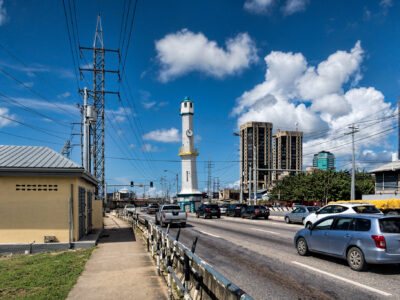
Trinidad and Tobago’s capital, Port of Spain, with its historic lighthouse. Photo by Dan Lunberg on Flickr (CC BY 2.0).
Trinidad and Tobago’s Special Operations Bill 2026 is primarily a response to crime and insecurity. It establishes seven policing districts in which special operations could be conducted, with police officers able to receive military assistance from the Defence Force. The proposed legislation also provides for closed areas, curfews, cordons, searches, reporting requirements and training in areas including human rights, use of force and community engagement.
Much of the public discussion around these measures understandably focuses on policing powers and civil liberties. There is another aspect, however, that is worth considering from a development perspective. It is creating a particular way of organising the country’s security geography, and that part of the proposed legislation deserves more attention. There is nothing unusual about using large administrative areas to organise public services. The issue is that a policing district isn’t necessarily the same thing as a community, local economy or a development area. This distinction becomes important when a state begins to use the same geography to understand where particular security problems are concentrated.
Security map vs. development map
An area such as San Juan/Laventille, located in north-central Trinidad, contains communities with different histories and circumstances. This is also the case in Couva-Tabaquite-Talparo (central) and Penal-Debe (south Trinidad). A district can be administratively convenient while still containing considerable differences in income, employment, infrastructure, access to services, and relationships between residents and public institutions.
For development policy, these differences are not coincidental; they are the starting point for understanding why an intervention works in one community and has limited effects in another. To an extent, the current proposed legislation does recognise that local circumstances matter. A closed area can only be declared where the President is satisfied, on reasonable grounds, that public safety and peace are threatened by circumstances that include escalating violent crime, the prevalence of illegal firearms, or gang control and intimidation of a local community. The declaration must set out the grounds for the measure and be presented to the House of Representatives. However, once the state identifies an area, it must also ask the question, “What else is known about the area?”
Crime data can tell us about the occurrence of violence and patterns of criminal activity, but not necessarily why two communities facing apparently similar levels of violence respond differently to the same intervention. This requires a different kind of information — and an area where development practice can add something to the security conversation.
The IDB’s 2024 guide on hot spot policing in Latin America and the Caribbean makes a similar point from a policing perspective. It describes hot spot policing as an evidence-based approach for concentrating police activity where crime is concentrated, but it also strongly emphasises evaluation, the possibility of displacement, and the need to complement policing with other approaches if reductions in crime are to be sustained.
For Trinidad and Tobago, identifying a security hot spot is only one part of understanding a place. The same location may also be a centre of employment, have weak infrastructure, strong local organisations or youth vulnerabilities. These different characteristics may not be captured in a single dataset, highlighting the need for making better use of the territorial information that emerges when the state concentrates its attention on particular places.
Lessons from the region
Jamaica’s Zones of Special Operations offer a relevant regional comparison. When the legislation was introduced in 2017, it combined security measures with a former social intervention structure. A Social Intervention Committee (SIC) assigned to each zone was given responsibility for assessing physical infrastructure, health conditions, housing and social amenities, and developing a sustainable development plan covering health, the environment, social improvement, education, and economic development. The approach is now at a particularly interesting point.

In June 2026, the Jamaican government announced a comprehensive evaluation of its seven ZOSOs, with research intended to examine their financial costs and benefits, social value, unintended consequences and longer-term social and environmental outcomes. The research is also intended to inform a possible transition from ZOSOs to zones of peace and opportunity.
There are useful lessons here for Trinidad and Tobago, including the difficulties. A security intervention can generate considerable information about a place without necessarily producing a stronger understanding of why insecurity persists there. That requires institutions capable of bringing different forms of knowledge together and following what happens after the immediate security intervention.
Brazil provides a different perspective. Rio de Janeiro’s Pacifying Police Units, introduced from 2008, were intended to establish a more permanent state presence in communities that had been dominated by organised criminal groups. A World Bank study of the approach looked beyond crime and policing and examined changes in community life, relationships between residents and the state, economic opportunities, and the lived experiences of residents. The initiative produced different experiences across communities and eventually faced serious problems of sustainability that demonstrated why the longer-term relationship between security, public institutions and communities needs to be considered at the outset.
Colombia opted to deal with the same broad problem via its Programmes for Development with a Territorial Approach (PDET), in 170 municipalities most affected by poverty, violence, illicit economies, and weak institutional presence. The programmes are 15-year planning and management instruments meant to stabilise and transform these areas.
The PDET model, since it is not really a security intervention, is not directly comparable to special operations. Its relevance is in the way it treats territory as an important unit of development planning: the underlying idea is that places affected by conflict and weak state presence may require sustained attention to the area itself, as opposed to individual programmes delivered by separate agencies. This distinction is useful when looking at Trinidad and Tobago’s proposed legislation, which is primarily concerned with the security response.
An earlier Bill, which was defeated in Trinidad and Tobago’s Senate in January, was more explicit about linking security interventions with community development. It proposed a Social Transformation Committee that would assess conditions within a zone, identify threats to sustainable development, develop a sustainable development plan, and recommend social interventions.
This does not mean that the police should become a development agency but rather that public institutions are looking at the same communities through different lenses. The police service may know a community through incidents, intelligence, and calls for service; the Ministry of Education may know it through attendance and school performance. Health agencies, meanwhile, may have information about access to services, local government may know its infrastructure problems, and community organisations may have a more detailed understanding of youth who are vulnerable to gang recruitment. Bringing these forms of knowledge together would not make crime disappear, but it could provide a better understanding of why certain areas require repeated interventions and why others move in a different direction.
The regional discussion is moving in this direction, as well. The CARICOM-UNDP Diagnostic Document released in May 2026 examines crime and violence alongside governance, inequality, youth vulnerability and other development pressures. Rather than treating violence as an issue belonging to the security sector alone, it places these issues within a broader human security and prevention framework.
What Trinidad and Tobago can learn
There is a growing body of Caribbean and Latin American experience on territorial approaches to violence, policing, public institutions and development, including the wider development implications of states of emergency and exceptional security measures in the region.
Rather than returning to the effects of emergency measures on economic and social life, it is worth looking at how the state defines the places in which it intends to concentrate its security response and whether those places can also become units of better public policy and learning. This may become particularly important because the legislation contains a two-year sunset provision. Therefore, the country should be able to look back at more than the number of operations conducted, arrests made, or weapons recovered. It should also have a clearer picture of what happened in those communities and which changes were sustained.
Jamaica’s current evaluation is instructive in this regard. Almost nine years after its first ZOSO was established, the country is now asking what has worked, what has not, what the interventions have cost and what the longer-term social and environmental effects have been. This does not mean each special operation needs to become a social programme, or that development spending can replace policing where serious criminal activity is taking place — but the geography of a security problem can be a useful starting point for understanding a development problem.
A community is more than the total of incidents recorded there. It has schools, businesses, families, and public institutions that shape how people experience both insecurity and government intervention. The seven policing districts proposed in Trinidad and Tobago may provide an administrative structure for the security response, but not necessarily an adequate picture of the communities within them.
This distinction matters. Jamaica has spent almost a decade combining territorial security interventions with social transformation and is now evaluating the results. Colombia has used long-term territorial planning in municipalities affected by violence, poverty, and weak institutional presence. Brazil’s experiences with pacification in Rio demonstrate the difficulties of sustaining a new state presence when the wider institutional and social changes do not develop at the same pace.
Trinidad and Tobago does not need to adopt any of these approaches wholesale, but if particular locations are going to receive sustained attention because of their security conditions, they could also become places where the government develops a much clearer understanding of the local conditions associated with insecurity, the institutions already working there, and the interventions that make a difference. This would make the exercise about more than drawing boundaries around where special operations can take place — it would help us understand the intricacies of the places within those boundaries.