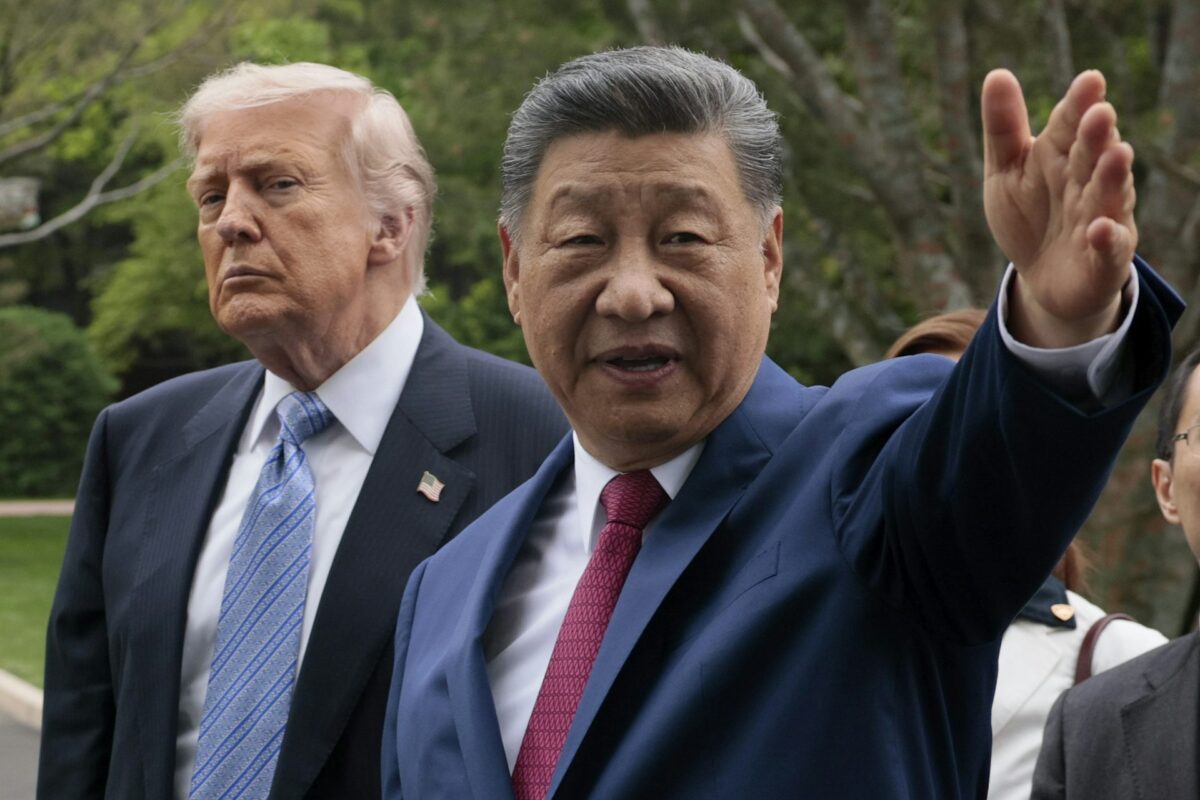
When Presidents Donald Trump and Xi Jinping last sat down in May 2026, talk was centered on three Ts: trade, technology and Taiwan.
The latest summit, due to begin in the United States on Sept. 24, looks set to focus on the same set of issues again. The main difference will be that the technology element has been given added urgency by the sudden and rapid shift in developments in artificial intelligence.
What’s less clear is whether the two sides will be able to come to any sort of transformative agreement on that, or any other issue.
Tweaks to trade?
The most urgent issue, but also the simplest to solve, will be on trade.
Nearly a year ago at Busan in South Korea, Trump and Xi hammered out an agreement whereby the U.S. agreed to lift some export controls on high-end technology and to reduce the then three-figure tariffs on Chinese goods. For its part, China agreed not to restrict the flow of critical minerals and rare earths to U.S. users.
That pact is now up for renewal. Both sides are likely to want a continuation of the current arrangement, and while there may be some tweaking on the side, the new deal will probably be similar to the old one.
Each side has proposed in previous meetings that there should be a new instrument, a Board of Trade, that will assess non-sensitive U.S.-China business interests.
However, details about the institution remains vague. Some announcements are likely during the summit, but business leaders will want to know how comprehensive and lasting the arrangements for the board will be.
There is still less information on a proposed Board of Investment, which remains on the drawing board. The Chinese side has proposed bringing major Chinese CEOs to the summit to match the likes of Nvidia’s Jensen Huang and Tesla’s Elon Musk – both of whom accompanied Trump on the Beijing trip.
But the choice of business leaders is likely to turn on which aspects of trade China thinks are likely to develop most effectively in the short term.
The always thorny issue of Taiwan
Taiwan is a much harder issue to solve, but it’s unlikely that much that is discussed on Xi’s visit will determine its outcome.
Trump has been less willing than his predecessor to commit the U.S. to defending the island should Beijing invade, instead reasserting Washington’s long-held position of strategic ambiguity.
And although the U.S. is currently distracted from East Asia by the Iran conflict, China still prefers to find methods short of war to bring the island under Beijing’s control.

Daniel Ceng/Anadolu via Getty Images
The island’s January 2028 presidential election is likely to be a more crucial moment for Taiwan’s future, particularly if the opposition — and more China-friendly — Kuomintang party wins the presidency, or indeed if an isolationist candidate becomes U.S. president later that year. If the next U.S. president opted to change course by taking a less active involvement in overseas issues — as has been floated by early contenders on both the left and right — that would change things all the more.
For now, Beijing will continue to build the People’s Liberation Army’s naval capacity to have the option of military action against the island. But its preference will be to take advantage of changes within Taiwan’s internal politics while combining economic incentives and coercion, squeezing Taipei’s international footprint and hoping for a slackening of U.S. interest in the western Pacific.
Other international issues are likely to gain less attention. China is expected to make clear its unhappiness about the war on Iran, and the U.S. may remind China that it has passed new legislation allowing sanctions on countries that buy Russian oil – of which, China is the largest purchaser. However, neither issue is likely to lead to any major change in practice.
Turning to tech
It’s really in the area of tech, and AI in particular, where both sides will be trying to make diplomacy catch up with reality. The May summit surprised many because the question of mutual agreement on regulation of AI came up in a way that had not been on the agenda for the first year of the Trump administration.
However, both sides agreed that talks in principle about regulation might be possible and even desirable because of the growth in the importance, but also unpredictability, of AI. And on Sept, 20, the U.S. and China mooted the idea of a “hotline” to notify the other over AI national security risks.
Between the May and September summits, fears about AI in the U.S have created an increasingly unfriendly atmosphere toward unregulated AI.
In China, public sentiment about AI is less openly hostile and some of its major benefits in areas such as healthcare have softened people’s attitudes. Yet there are still plenty of concerns expressed in private about whether China’s troubled economy will definitively benefit from the AI boom. Although many argue it has created new opportunities for consumers, others point to the relatively few jobs that have been created for a workforce that finds itself buffeted by wide-scale job elimination.
Both the U.S. and China have reasons to talk about AI regulation. The alarming prospect of rogue AI companies causing intense social disruptions through their business choices is clearly one such reason, and in the U.S., voters’ more immediate concerns about data centers are another.
There are also China-specific reasons that Beijing may seek restraint. One of the most common concerns about AI is that it may well run out of control. And “out of control” is a kryptonite phrase for the leadership of the Chinese Communist Party. That’s particularly true of Xi who, as a youth, spent years in rural exile after his father fell to a purge just before the Cultural Revolution – an upheaval during which China’s politics turned to anarchy. It was a formative experience for Xi, which has no doubt influenced his tendencies as a leader toward exercising as much control as possible.
AI that undermines the unchallengeable leadership of the Communist Party would be an unwelcome guest in China’s cyberspace, and regulation that solves that problem would not be rejected out of hand.
However, this recognition of mutual concern about AI – albeit for very different reasons – is still not likely to see much progress in the short term. The competition between the U.S. and China on AI is real, and neither governments nor private sector actors in either country are willing to make concessions that could advantage the other side.
Levels of trust between Washington and Beijing remain very low on the issue. Talks about talks seem the most likely public outcome, though what happens behind the scenes may be pursued more discreetly.
It’s good to talk
The Trump-Xi summit is less important in terms of any major change in policy on either side, and more because it marks part of a commitment to maintain some form of dialogue between the leaders of the world’s two most powerful countries. The leaders may well meet twice more in the near future, at the G20 and APEC summits.
To meet four times in just over half a year is a good sign; refusal to meet would be much more worrying.
But the underlying difficulties of the three Ts, where the leaders seem to have fundamentally incompatible agendas, remain the thread beneath the ostensibly polite and occasionally amiable conversations.

Rana Mitter does not work for, consult, own shares in or receive funding from any company or organization that would benefit from this article, and has disclosed no relevant affiliations beyond their academic appointment.