Russian soldiers are appearing alongside saints in artwork at Russian Orthodox Churches
Originally published on Global Voices
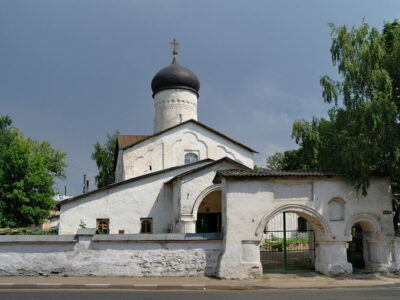
Church of Saints Cosmas and Damian of Primostye. Address: 7 Leona Pozemskogo Street, Pskov. Date: 2010. Source: Licensing: Ostrogolovy, from Russian Wikipedia, the copyright holder of this work, has voluntarily released it under the Creative Commons CC0 1.0.
The Russian authorities and the Russian Orthodox Church, which has expressed its full support for the Russian full-scale invasion of Ukraine and continues to do so, have appropriated the traditional Pskov style of Orthodox icons in support of the war in Ukraine.
In the spring of 2026, the Pskov Oblast governor wrote in his Telegram channel that two soldiers who died in combat during the Russian aggression in Ukraine have been depicted as icons, which are displayed in one of the famous Pskov churches.
Both paratroopers shown on the icons were professional soldiers from Russia’s 76th Air Assault Division, based in Pskov. Both had taken part in the war against Ukraine from the first day and were killed there in 2023.
The icons were donated by a city municipal deputy to the Church of Saints Cosmas and Damian of Primostye. It is one of Pskov’s oldest churches, located opposite the Pskov Kremlin. Founded in 1462, it is a cultural heritage site of federal significance and forms part of the ensemble “Churches of the Pskov School of Architecture,” which was inscribed on the UNESCO World Heritage List in 2019.
The icons are painted in a traditional Pskov style, as described in Encyclopedia Britannica:
“In the course of the 13th and early 14th centuries…Pskov perfected an extremely forceful style of icon painting that to the end of its development combined a remarkably skillful expression with a somewhat archaic, even naive, manner of presentation”

Example of Pskov art school fresco by an unknown painter. Circa 1140 CE. Image via Wikipedia Commons. Public Domain.
The two newly painted icons depict St. Nicholas of Mozhaysk as the main figure, and a soldier who died while participating in Russian aggression against Ukraine is also shown as a smaller figure at his feet. In the other, St. Rusticus of Paris appears above another killed Russian soldier.

Part of the new icon depicts a figure of a Russian soldier who died during the full-scale invasion of Ukraine that started in February 2022. Screenshot of the video from the Telegram channel of the Pskov Oblast governor. Fair use
As Radio Liberty’s experts explain, this follows an old Orthodox tradition in which donors, soldiers, or other ordinary people could be shown praying before a saint without being presented as saints themselves. But the main issue here is the political meaning they have today. The Russian Orthodox Church has strongly supported the war, and these images place specific soldiers who fought in Ukraine inside the sacred space of traditional Orthodox art in the Pskov icon school.
In this way, traditional Pskov icon painting is being appropriated for state war propaganda. The soldiers are not officially declared saints, but their deaths are given a sacred meaning. The traditional Pskov Orthodox visual language of prayer and religious memory is used to make Russia’s war appear morally and spiritually justified
It is worth noting that Pskov, at the time when this school of art appeared, was not subjected to Moscow’s rule. As Britannica notes, “In 1510, Moscow, having conquered much of central Russia, annexed Pskov as part of the growing national state.” Before that, the Pskov Republic was a city-state in northwestern Russia that won formal independence from the Novgorod Republic in 1348.