Marcel Duchamp’s “Fountain” is not for everyone – and it does not need to be.
But it does encapsulate a central concern in the philosophy of art: What makes something art, and who gets to decide?
Whatever our tastes, art can challenge accepted systems and make us reconsider what we think we know.
Duchamp’s friend and chess partner John Cage observed in 1988, “I can’t understand why people are frightened of new ideas. I’m frightened of the old ones.” “Fountain” embodies this thinking.
A version of “Fountain” is part of the Philadelphia Museum of Art’s permanent collection and will appear in the museum’s upcoming Duchamp retrospective, which opens Oct. 10, 2026, and runs through Jan. 31, 2027. The exhibition will revisit Duchamp’s enduring questions about what art is and what it can be.
As an art historian and former Philadelphia Museum of Art staff lecturer, I have developed an intimate knowledge of Duchamp’s art through years of teaching his work. During and after my tenure at the museum, I presented 101 lectures and led 25 gallery-based programs. Some of these focused directly on Duchamp, while others explored broader questions about originality, authorship, intention, skill and value.
These questions are embedded in the remarkable story of “Fountain.”

Mark Kauffman/Getty Images
Courting ‘ready-made’ controversy
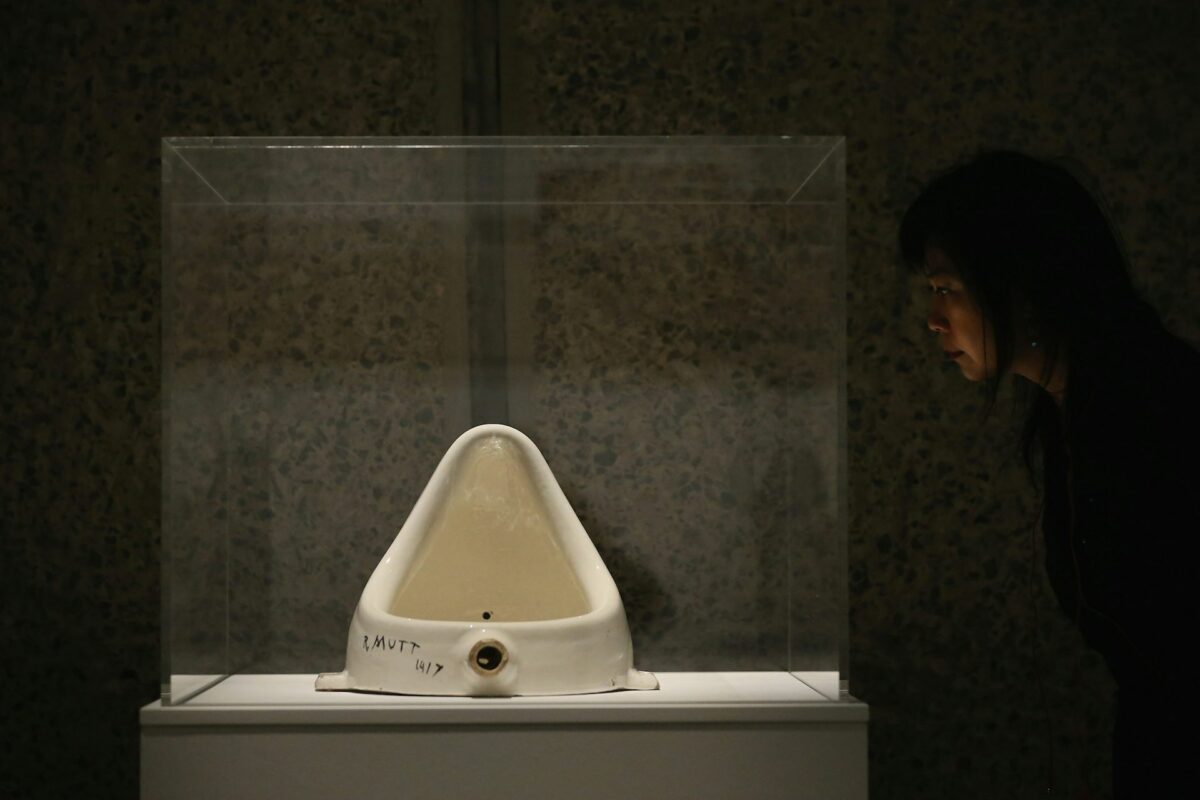
The 1917 original “Fountain” survives only in photographs, but 14 authorized full-scale replicas followed. The Philadelphia Museum of Art owns the earliest, signed by Duchamp in 1950.
“Fountain” continued a press narrative about Duchamp’s work that had begun four years earlier when his 1912 painting “Nude Descending a Staircase (No. 2)” became a sensation at the 1913 Armory Show in New York City. Journalist Julian Street remarked that it resembled “the explosion of a shingle factory.”
Former president Theodore Roosevelt declared that a Navajo rug in his bathroom was “a far more satisfactory and decorative picture” than the cubist artists on display at the armory.
By 1917, Duchamp knew that controversy could compel audiences to debate what qualified as art. With “Fountain” that debate became part of the artwork.
Its story began with the Society of Independent Artists exhibition in New York in April 1917. Duchamp had helped found the society and establish its democratic premise that every member could exhibit without a jury. He tested that principle by purchasing a porcelain urinal, turning it on its side, signing it “R. Mutt 1917” and submitting it under a pseudonym.
The organizers excluded it from the official display and placed it behind a partition outside the main exhibition area. Collector Walter Arensberg, Duchamp’s friend and fellow board member, defended it and reportedly intended to purchase it. Both men resigned in protest.
Alfred Stieglitz photographed “Fountain” at his 291 gallery positioned in front of Marsden Hartley’s 1913 painting “The Warriors.” The painting depicts a German military parade, and the title of the painting suggests a battle between old and new ways of thinking. Stieglitz’s photograph appeared in the May 1917 issue of The Blind Man, a short-lived New York avant-garde art magazine, alongside an editorial that argued that Duchamp’s act of choosing an ordinary object created “a new thought for that object.”
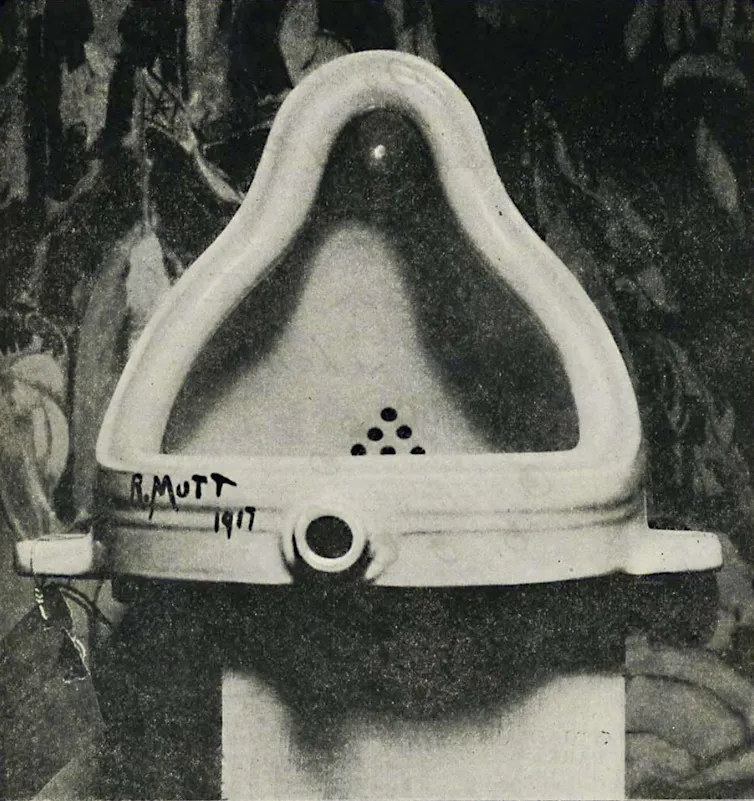
Alfred Stieglitz, The Blind Man No. 2, May 1917, The University of Iowa Libraries
Duchamp called such objects “readymades,” a term historians believe he first used in a letter to his sister Suzanne dated Jan. 15, 1916. His first so-called readymade was “Bicycle Wheel” (1913), which joined an inverted bicycle wheel to a wooden stool. The lost original survives through replicas, including an authorized version from 1964 that’s held at the Philadelphia Museum of Art.
“Bicycle Wheel” proposed that art doesn’t have to be handmade. An object can become art because the artist selects it and invites us to think about it differently.
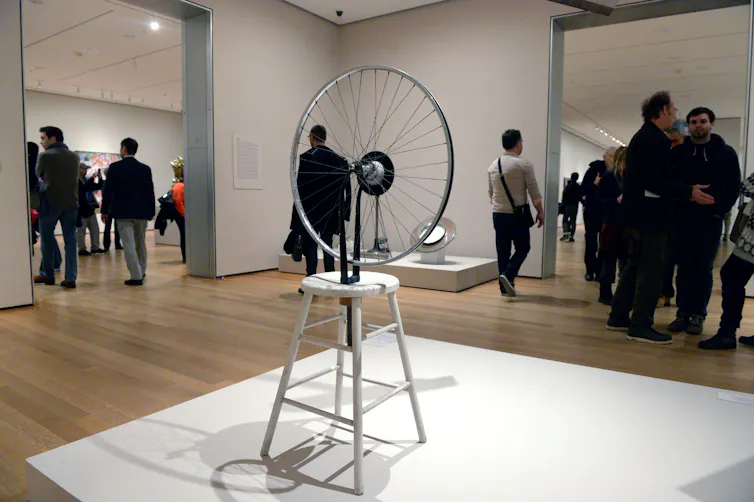
Felix Hörhager/Picture Alliance via Getty Images
Making the viewer part of the art
Duchamp studied at the Académie Julian in Paris and was fully capable of traditional drawing and painting. He arrived at the readymades not because he lacked technical ability, but because he prioritized art that engaged the mind over what he called “retinal art,” art that primarily pleased the eye.
Seeing “Fountain” in Philadelphia provides a key to two of the museum’s other great Duchamp works: “The Bride Stripped Bare by Her Bachelors, Even (The Large Glass)” and “Étant donnés.” The eroticism that “Fountain” implied with its associations to bodily functions evolved into frustrated desire in “The Large Glass.” In “Étant donnés,” the eroticism becomes explicit and voyeuristic, as it asks viewers to peer through holes in a weathered door.
Duchamp’s nod to manufactured plumbing systems in “Fountain” also anticipates his exploration of mechanical themes. In “The Large Glass,” the nine bachelors form part of an elaborate mechanical apparatus. In “Étant donnés,” an electric motor inside a cookie tin rotates a perforated disc, creating the illusion of a moving waterfall.
All three works shift art away from a self-contained image and toward an encounter involving object, idea, context, chance and viewer. “Fountain” transforms plumbing through the artist’s selection. “The Large Glass” incorporates chance through cracks created when it was shattered accidentally in transit – damage Duchamp repaired and embraced. “Étant donnés” incorporates found materials, including an old wooden door Duchamp obtained in Cadaqués, the Catalonian village where he and his wife, Alexina “Teeny” Duchamp, spent their summers.
Together, the works demonstrate that art can be a question to contemplate, a system to decipher, or an experience our actions complete. Seen together in Philadelphia, they reveal how consistently Duchamp made the viewer central to artistic meaning.
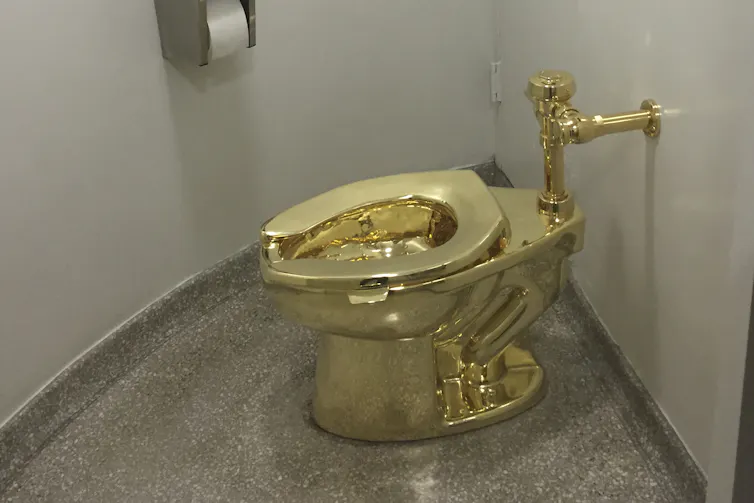
William Edwards/AFP via Getty Images
It’s OK to laugh – or scowl
Despite its philosophical seriousness, “Fountain” is deliberately absurd and comical. It is appropriate to laugh. I’ve seen viewers even get angry and irritated. Its irreverent humor, provocation and rejection of artistic convention place it within Dada, a movement that began at Zurich’s Cabaret Voltaire in 1916 as an absurdist protest against the nationalism and supposedly rational values that had led to World War I. Dada became an international movement active in Berlin, Paris and New York, and it transformed modern art.
The legacy of the readymades, especially “Fountain,” is difficult to overstate. They paved the way for Louise Nevelson, who transformed discarded pieces of wood into monumental assemblages, and Andy Warhol, who elevated Campbell’s soup cans into icons of American culture. Maurizio Cattelan addressed Fountain directly in 2016 with “America,” a fully functioning toilet cast in 18-karat gold.
Nearly a century later, Cattelan echoed Duchamp’s questions about where artistic value resides: Is it in the object, its material, its price, its context, the artist’s idea or the institution declaring it art?
This leads to the great paradox of Duchamp’s legacy. Art conceived to challenge permanence, originality and inherent value has itself become permanent, invaluable and iconic.
Read more of our stories about Philadelphia and Pennsylvania, or sign up for our Philadelphia newsletter on Substack.

Matthew Palczynski does not work for, consult, own shares in or receive funding from any company or organization that would benefit from this article, and has disclosed no relevant affiliations beyond their academic appointment.