China has launched three commercial satellites designed to detect and locate radio-frequency signals from space, adding a new capability to its expanding commercial satellite sector.
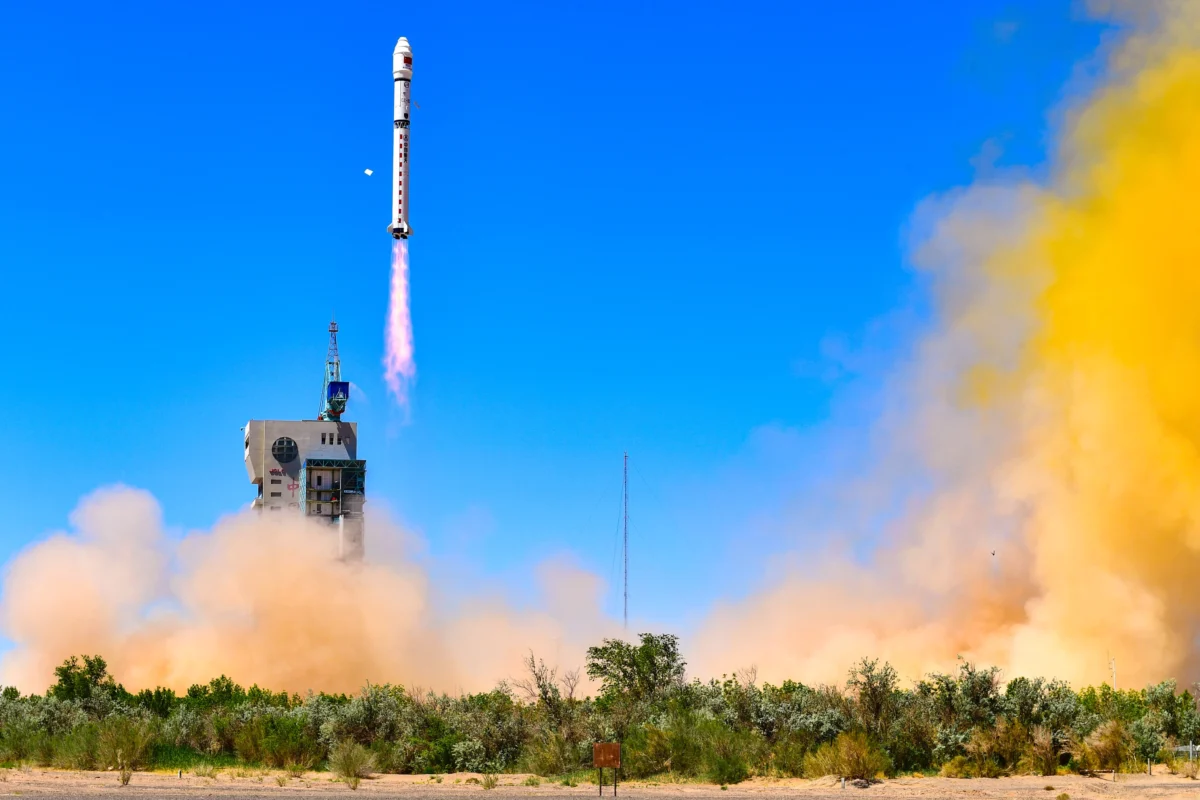
A Lijian-1 Y18 rocket launched nine satellites on September 20 from the Dongfeng Commercial Space Innovation Test Zone. The payload included the Diting-01 A, B and C satellites, which entered their planned orbits.
The three satellites form the first group of China’s Diting constellation. Tianjin Xingkan Jiuzhou Technology operates the constellation, while Chang Guang Satellite Technology developed the spacecraft.
Chinese sources describe Diting as the country’s first commercial satellite constellation to use a three-satellite formation for radio-frequency data collection. The system is designed to sense electromagnetic activity over wide areas and rapidly locate radio transmitters.
That capability has clear dual-use potential.
Radio-frequency sensing can locate signals from communications equipment, radars and other transmitters without requiring access to the equipment itself. Multiple satellites can observe the same signal from different positions and use those measurements to estimate its location.
For civilian customers, such data could support spectrum management, maritime monitoring and other applications. For military users, the same technology could help identify the location and activity of radars, communications networks or electronic jammers.
There is no public evidence that Diting has been deployed as a Chinese military electronic-warfare system. Its current mission is described as an on-orbit test of space-based RF-sensing technology.
A network of RF-sensing satellites could monitor electromagnetic activity across areas that ground stations cannot easily reach. A larger constellation could also increase coverage and shorten the time between observations.
The technology has a commercial precedent. US company HawkEye 360 operates satellites that locate and characterise radio-frequency emissions, with applications spanning commercial and government customers.
China’s Diting programme shows that similar capabilities are now emerging within its commercial space industry.
The September 20 launch was the 16th flight of the Lijian-1 rocket and carried nine satellites in total.
For now, Diting remains a technology demonstration rather than proof of a new Chinese military surveillance network.
But if China expands the constellation, commercial satellites could provide increasingly persistent data on electromagnetic activity across land and sea. That could make space-based RF sensing another important layer of China’s growing space and security infrastructure.