For most of the population, unreliable electricity has become a chronic part of daily life
Originally published on Global Voices
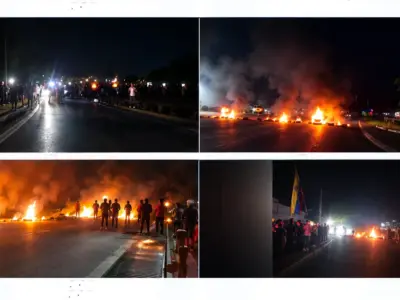
Screenshots of protests in four states in Venezuela (Zulia, Lara, Portuguesa and Falcón) amidst power cuts across the country, taken from the YouTube video by NTN4 “Venezuelans can’t endure power cuts anymore and take to the streets in protest,” published on September, 3, 2026. Fair use.
This piece is part of Global Voices’ September 2026 Spotlight series, “Protest in Democracy.” With this Spotlight, we seek to explore the many forms of protest, the tactics states use to delegitimize and suppress them, and the complex relationship between protest and democracy. You can support this coverage by donating here.
“Yesterday we didn't have electricity for 11 hours. The day before, it was seven,” explains Yanira, a 33-year-old artist and designer who lives with her ailing 73-year-old father in Maracaibo, one of the cities most affected by Venezuela’s electricity rationing. In a region where temperatures remain high throughout much of the year, going without electricity is more than an inconvenience. For her family, the blackouts directly affect their health, work and daily routines.
And Yanira is not alone.
Across the country, increasingly long and unpredictable blackouts are disrupting work, education, businesses and sleep. In several cities, frustration has spilled into the streets, with residents protesting outages and blocking roads in the darkness.
In August, residents of various cities, including Turmero and Valencia, took to the streets at night to protest the worsening situation. Their demonstrations came as authorities expanded electricity rationing in response to growing pressure on the country’s fragile power grid.
The crisis is particularly severe outside Caracas, where scheduled outages lasting between six and 15 hours a day have been reported in several regions. Authorities have also introduced shorter working hours for some public sector employees, and reached an agreement with shopping malls to reduce electricity consumption.
The government has attributed the worsening shortages in part to the effects of El Niño, which has brought drought and unusually high temperatures to Venezuela. There is also, however, a series of factors worsening the situation, like the major failure at Guri Hydroelectric plant, where one of its turbines — which generated 770MW — collapsed.
The country’s electricity problems long predate the current weather conditions. Venezuela’s power system has suffered from years of underinvestment, poor maintenance and allegations of corruption, resulting in a system that is increasingly unable to meet the country’s electricity needs.
A crisis measured in lost hours
For residents of Maracaibo, one of Venezuela’s largest and most economically important cities, the crisis has become deeply personal. Yanira says she can spend at least six hours a day without electricity. The outages have affected both her livelihood and her mental health.
She has had a hard time finding a job or even working remotely, because blackouts make it difficult to function. She eventually began running small businesses from home, first selling sandwiches and cepillados zulianos — shaved-ice treats popular in the region — but keeping food frozen and drinks cold is a constant challenge when electricity can disappear without warning:
The hardest moments come at night. Without air conditioning, sleeping becomes difficult in Maracaibo’s intense heat — and while opening the windows brings some relief, it also lets tropical insects inside. Yanira says the situation has affected her sleep so severely that she began taking sleeping pills.
Her experience reflects a broader problem. According to Venezuela’s 2025 Living Conditions Survey, only around 10 percent of Venezuelans live without experiencing power outages. For most of the population, unreliable electricity has become a chronic part of daily life.
The blackouts are also taking a toll on local economies. The National Chamber of Commerce reported that 38 percent of businesses had closed during the year, amid the combined effects of the electricity crisis and the country’s broader economic difficulties.
In Puertos de Altagracia which, like Maracaibo, is situated in Zulia state, Sara Hernández works at a company that sells bottled drinking water. Even with access to a generator, keeping the business running during outages is difficult because fuel is not always available. The uncertainty makes planning almost impossible. Electricity can disappear at any moment, and some businesses experience more than one rationing period in a single day.
The consequences extend beyond commerce. In Maracay, in Venezuela’s central region, resident Kellys Gallardo told El País that she receives daily text messages from the state electricity company, Corpoelec, warning her about planned outages, but the messages sometimes arrive only after the power has been cut.
Gallardo, who works at a company that manufactures printer ink cartridges, experiences outages both at work and at home. Her children are also affected when electricity rationing disrupts their schools.
From frustration to protest
As blackouts grow longer and less predictable, anger is becoming increasingly visible in public spaces. Residents who once endured outages quietly are now gathering in the streets, blocking roads and demanding solutions. In cities like Turmero, Valencia, El Tocuyo, Caja Seca, Calabozo, Zaraza and Valle de la Pascua, nighttime protests have highlighted how deeply the electricity crisis has entered everyday life.
The year 2026 saw a significant surge in both the frequency and widespread nature of civil unrest across Venezuela. The Observatorio Venezolano de Conflictividad Social (OVCS) documented upwards of 4,000 protests between January and August, a figure that OVCS coordinator Marco Antonio Ponce noted is triple the amount seen in earlier comparable timeframes. Daily demonstrations averaged 22 in August alone, with persistent electricity blackouts ranking among the public’s primary grievances.
For Venezuelans, the problem is about more than having to sit in the dark. It means businesses losing products and working hours, children having no electricity at school, families struggling to sleep in extreme heat, workers unable to plan their days, and people unable to access healthcare. In the Barquisimeto dialisis unit, for example, a lack of power left 42 kidney patients without treatment.
A problem that has lasted for years
Venezuela’s current electricity emergency echoes its 2019 crisis, when severe drought reduced water levels at the Guri reservoir, the hydroelectric complex that supplies a major share of the country’s electricity. One the most important events of this period was a 6six-day national blackout.
Today’s crisis is unfolding on top of years of deterioration in the electricity system. Venezuela has an installed generation capacity of approximately 30,000 megawatts, but currently produces less than half of that amount. The gap becomes particularly problematic during periods of high demand.
The government recently announced new investments aimed at rebuilding the system. In June, authorities signed an agreement with U.S.-based General Electric to restore 1,000MW of generating capacity over two years, with plans for an additional 5,000MW over the following four years.
Another agreement involving the Tocoma hydroelectric project, which began construction in 2007 but was never completed, was also announced. Authorities say these projects form part of a broader effort to recover Venezuela’s electricity infrastructure.
For residents living through the outages, however, long-term plans offer little immediate relief. In a country where electricity shortages have persisted for years, each new blackout carries the weight of a much longer story: one in which an essential public service has become increasingly unreliable, while residents are left waiting for the lights to come back on.