Push-in attempts by BSF stretch across Bangladesh’s land border, hitting all four edges of the map
Originally published on Global Voices

India–Bangladesh Friendship Gate at the Tamabil-Dawki border in northeast Bangladesh. Image via Wikipedia by Ankan. CC BY-SA 4.0.
This report features interviews and infographics by Amatullah Sumaya, Aronee Ayub, Nusaiba Nawaz, Sampoorna Ganguly, and Sayeeda Nowshin for the Data Journalism Course at the University of Liberal Arts Bangladesh.
A 55-year-old physically challenged stranger appeared on the Bangladesh side of the India-Bangladesh border in Chapainawabganj in June 2026. By the time Border Guard Bangladesh (BGB) reached him, a crowd had gathered around him.
He could not hold a pen — not because he did not know how to write, but because he had no fingers with which to hold it.
“The matter came to our attention after Shreejib Kumar Singh was found on the Bangladesh side of the border in the Chapainawabganj area,” the officer-in-charge of Gomastapur Police Station told Global Voices in a WhatsApp interview in August, recounting how the incident was reported to police.
According to the information we received, he had entered Bangladesh from the Indian side.
But Singh had a very different account of how he came to be there. He gave police an address in India: Shamsahapur, under Uda Kishanganj Police Station in Bihar’s Madhepura district. He identified himself as an Indian citizen and said he had documents, including an Aadhaar card, to support that claim.
Singh told us that he was an Indian citizen and that Indian authorities had flagged him as a Bangladeshi national and pushed him across the border into Bangladesh.
Singh, according to the officer, remained firm on that point.
“He denied that he had voluntarily crossed the border. His position was that he had been brought to the border and pushed into Bangladesh,” the OC said.
What happened next transformed a disputed border crossing into a criminal case.
On the Bangladesh side, Singh became an accused in a case filed at Gomastapur Police Station—Case No. 19, G.R. No. 128, under Section 4 of the Control of Entry Act, 1952. Police records indicate the alleged incident occurred at around 12:30 p.m. on June 23rd, 2026.
“This matter is now before the court; the final determination will come through the legal process,” the OC said.
Singh’s case sits inside a ledger that has grown rapidly in recent years.
Five corners, one pattern
Since the political transition in Dhaka following the monsoon revolution in August 2024, the land frontier separating India and Bangladesh has re-emerged as one of the most contentious flashpoints in South Asian bilateral relations, largely due to a practice that Bangladeshi authorities term “push-in” and that Indian commentators more often describe as “pushback.”
The phrase denotes the informal, extra-legal transfer of individuals across the border by the Indian Border Security Force (BSF) without following the verification and repatriation procedures that both governments had earlier agreed upon.
Push-in attempts by BSF stretch across Bangladesh’s land border, hitting all four edges of the map.

Infographics designed by Amatullah Sumaya, Aronee Ayub, Nusaiba Nawaz, Sampoorna Ganguly, and Sayeeda Nowshin for this investigation under the Data Journalism Course at the University of Liberal Arts Bangladesh. Used with permission.
In the north, Rangpur’s frontier districts absorbed at least 11 attempts between June 2025 and July 2026, spread across Lalmonirhat, Dinajpur, Thakurgaon, Kurigram and Panchagarh. Panchagarh’s Haribhasa border alone took 23 people on August 12–13, 2025, one of four coordinated pushes that single night. Kurigram’s Roumari and Datbhanga points logged two further attempts in June 2026.
Rajshahi division carries the heaviest, steadiest attempts. Chapainawabganj’s border was hit six separate times over fourteen months, through Bholahat, Gomastapur, Rokonpur, Chowka and Charaldanga, pushing in 8, 20, 17, 1, 20, and 7 people, respectively.
Naogaon district reported four new incidents in Dhamoirhat, Sapahar, and Shitalmath, bringing the total number of people to 43.
Moulvibazar, in the northeast, recorded four dedicated pushes, at Sreemangal, Murichhara, Bakshitila and Kachurgul, moving 52 people between June 2025 and July 2026, plus a share of two larger multi-district reports covering 280 and 62 people.
Khagrachhari, in the southeast, tells a different story. It appears only twice, both in May 2025, when 38 people were pushed through its border with Habiganj, and it featured in the 280-person multi-corner report. No incident from this district surfaces afterward, a sharp contrast to the sustained pressure seen elsewhere.
Satkhira, in the southwest, shows a distinct method. Both recorded attempts, 23 people at Kushkhali in May 2026 and 15–20 via Sundarbans river routes in June, were fully blocked by BGB. Unlike the land-heavy corridors up north, this corner’s push-ins move by water, and both known attempts failed at the line.
Together, the five corners confirm one conclusion: Push-ins are not isolated incidents but a coordinated, border-length strategy, with Rajshahi absorbing the steadiest pressure while Khagrachhari and Satkhira show how geography shapes both method and outcome.
A pattern that emerges around elections
According to Border Guard Bangladesh (BGB), India pushed more than 2,300 people into Bangladesh between May 7, 2025, and late January 2026, including well over a hundred people who were later found to be Indian nationals themselves.
The Border Guard Bangladesh (BGB) repeatedly asked the Border Security Force (BSF) to stop these unilateral push-ins and use official repatriation channels; however, these requests were mostly ignored during successive talks.
According to BGB officials, the pace of attempted push-ins nearly doubled after the ruling Bharatiya Janata Party’s (BJP) win in West Bengal’s assembly election in April this year, with personnel and villagers foiling dozens of attempts within a single month.
In one Chapainawabganj incident, twenty people — eleven women, five men, and four children — were allegedly driven to the border before a BGB patrol turned them back. In another, 28 people were left stranded at the zero line near Gomastapur for over a day.
These numbers take on a new meaning when comparing the election cycles of both Bangladesh and India.
Bangladesh held its first parliamentary election since Sheikh Hasina’s government fell in August 2024 on February 12, 2026, and the Bangladesh Nationalist Party, led by Tarique Rahman, won a clear parliamentary majority. Rahman was sworn in as prime minister five days later.
Three months later, West Bengal went to the polls. The BJP, which had made illegal immigration a central campaign issue and pledged to “detect, delete, and deport” undocumented Bangladeshi migrants, won a majority in the state assembly, forming West Bengal’s first BJP government.
The two elections, arriving back-to-back, reshaped the border almost immediately.
The paper trail behind the push
The West Bengal Legislative Assembly Election in 2026 highlights the official documentation that both governments claim forms the foundation of the 2019 Citizenship Amendment Act (CAA).
That machinery has since moved to West Bengal in a new form. A “Special Intensive Revision” of electoral rolls functions as NRC by another name, reviving fears that swept Assam a decade earlier: of vanishing off a register through a clerical gap rather than any wrongdoing.
Opposition parties in West Bengal say nearly 9 million names were struck from the rolls during the revision, disproportionately affecting minority voters. After the BJP’s Bengal victory, the state government ordered a crackdown on undocumented migrants and announced holding centers for those awaiting deportation; it applies only to Muslim Bangladeshis, since the CAA exempts migrants of other faiths.
Union Home Minister Amit Shah has described this as a policy of “detect, delete and deport,” framing it as demography and national security rather than politics. India’s government, for its part, insists it is simply enforcing domestic law.

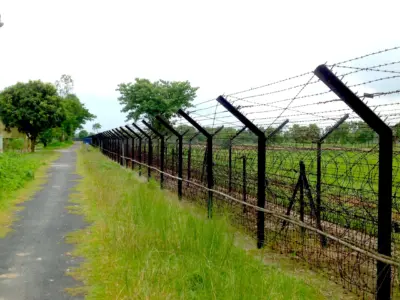
Indo-Bangladesh Border in Dakshin Dinajpur, West Bengal, India. Image via Wikipedia by Arupparia. CC BY-SA 4.0.
At director-general talks in June, the Indian side maintained it was repatriating illegal foreigners through established procedures, even as Bangladesh’s delegation called the practice illegal, inhumane and a breach of international law — a disagreement neither side has resolved.
The human cost of a political narrative
Human Rights Watch (HRW) has repeatedly highlighted that Indian authorities are expelling hundreds of Bengali-speaking Muslims, many of them Indian citizens, without due process. The United Nations has similarly urged both governments to resolve the dispute through dialogue rather than unilateral action.
“Naturally, this will further increase anti-Indian sentiment in Bangladesh,” says Imtiaz Ahmed, an international relations analyst, in remarks to Channel 24. “The two neighbors cannot coexist through a cycle of pressure and counter-pressure.”
On the ground, the language turns operational rather than political.
The 57th BGB-BSF conference in June produced a joint statement— a promise to bring border killings to zero and a pledge to reduce “infiltration” to zero— language nearly identical to commitments made at earlier rounds that were never kept.
Hours after that statement was issued, a Bangladeshi man was shot dead by BSF near the border, underscoring how far the agreement sits from the ground reality it is meant to govern.
With an elected Bangladesh Nationalist Party (BNP)-led government now in Dhaka and a Bharatiya Janata Party (BJP) government newly installed in Kolkata, the border no longer sits solely between foreign ministries; it sits inside the electoral calculations of two ruling parties at once.