Japanese artist Yayoi Kusama’s installations are big, bold and controversial. From the time she burst upon the pop art scene in the 1960s until her death on Aug. 14, 2026, at the age of 97, she challenged the Western, male-dominated art world. She also upended assumptions about mental disorders, which many people have uncritically seen as the source of her creativity. Her phallic sculptures and confounding mirror rooms are still popular, and they defy artistic classifications.
Kusama’s resistance to categorization raises an intriguing question: What is her lasting effect on the art world?
Kusama took a major step into the global art scene after sending two canvases for display at Amsterdam’s Stedelijk Museum on Feb. 5, 1962. After that, she shifted her direction to avant-garde sculpture. She created Accumulation No. 1, her first work in a series that employed sewn phallic protrusions. The series thrust her into New York City’s pop art scene and would lead to her fantastical Infinity Mirror Rooms installation.

J. Countess/Getty Images
A major retrospective of her work is on view at the Stedelijk Museum through Jan. 17, 2027.
The specter of her mental health issues, however, still undermines her art’s significance. Critics often link the repetition in her work to obsessive-compulsive disorder. But as an art historian who has studied Kusama extensively, I argue that she intentionally used compulsivity to examine gender issues in the art world. A close look at Accumulation No. 1 reveals how she pulled this off.
Phallic focus
Kusama’s emphasis on gender came into focus when she arrived in the male-dominated New York art world. During the 1940s and 50s, while abstract expressionism reigned in New York, women in the scene were treated as wives and assistants.
Painter Grace Hartigan had to adopt the pseudonym “George” to gain recognition. By the 1960s, that was starting to change. Venezuelan sculptor Marisol Escobar’s May 1962 exhibition at the Stable Gallery bucked the trend of gender conformity by integrating self-portraits into her sculpture series.
Kusama’s Accumulation No. 1 emerged as New York artists were seeking to move beyond abstract expressionism. The gestural paintings of this art movement were what some critics saw as an existential struggle toward originality coded as masculine. Pop artists refused this model: They turned instead to ready-made objects and impersonal repetition, evoking factory production.
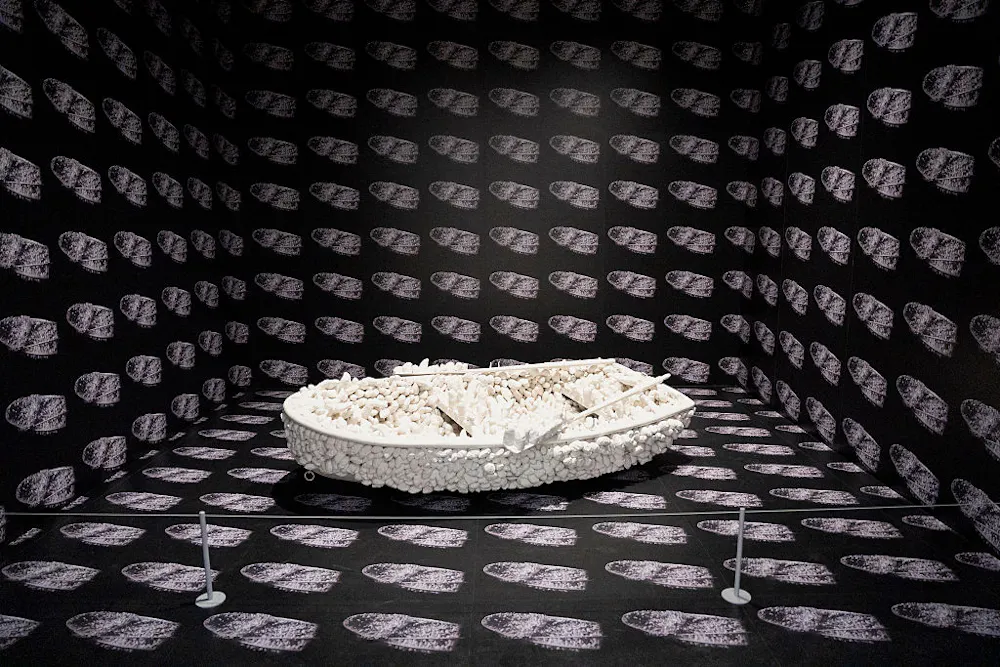
Kusama procured furniture and egg cartons for her Accumulation sculptures, as well as a wooden rowboat for another sculpture that became Aggregation One Thousand Boats Show. She decided to focus on sewing — an art rooted in her female Japanese education — and she ordered a sewing machine.
Lina Selg / AFP via Getty Images
Kusama embraced femininity by using phalluses – a symbol of patriarchal authority – made from assorted fabrics sewn into tubular shapes, filled with cotton and painted white. She upholstered an armchair with these protrusions, colonizing an eerie domestic scene with phalluses made through a traditionally feminine craft.
In this way, she transformed furniture into a vessel of complex meaning, with gender as the key component to interpretation.
Neurosis or intention?
Art critics and scholars have often interpreted the time-consuming process of creating these phalluses as evidence of obsessive-compulsive neurosis. But this assumption overshadows Kusama’s careful planning and deliberate choices in her art. Intensive manual labor is a common component of Kusama’s work.
In 2008, filmmaker Heather Lenz interviewed Kusama’s friend Helen Yrissary, who helped sew the protrusions on the armchair. She noted that while there were always five assistants who crafted the phalluses, only Kusama herself secured them to the chair. In Accumulation No. 1 and Accumulation No. 2, obsession was more of a calculated aesthetic and conceptual choice than a compulsive action.
Kusama knew about obsessive-compulsive disorder and the anxiety it can cause. Drawing on Sigmund Freud’s psychoanalytical theories, she explained in her autobiography that she developed the phallic image while she was exploring “kyōfu” – fear, or feelings of the uncanny – in the Accumulation series. According to Freud, the potential for the uncanny is rooted in a child’s first awareness of the anatomical differences between the sexes. He postulated that female children are traumatized when they realize they lack a penis, creating what he called penis envy.
Male authority
Kusama’s Accumulation series may have functioned as a satire of penis envy. And it may have led her to the idea of vanquishing men’s authoritative power.
In one of her self-portraits from 1966, Kusama flaunted a phallic protrusion near her crotch. This gesture suggests that the protrusion might be her own penis, that she might be bisexual or that she might not fall under the category of “female.” Such efforts to redefine female sexuality inspired many female artists at the time. Toward the late 1960s, artist Louise Bourgeois, who admired Kusama’s work, created several sculptures, including Fillette (Little Girl), that employed phallic shapes as commentary on psychological complexes and gender.
But when Kusama premiered Accumulation No. 1 and Accumulation No. 2, The New York Times gave her work only a brief mention. When, three months later, sculptor Claes Oldenburg showed his similarly sewn “metamorphic” sculptures, he received rave reviews in numerous art magazines, bringing him to the attention of the international art world. It was only much later in the 2010s, after Kusama gained global prominence, that Oldenburg admitted her influence on his work.
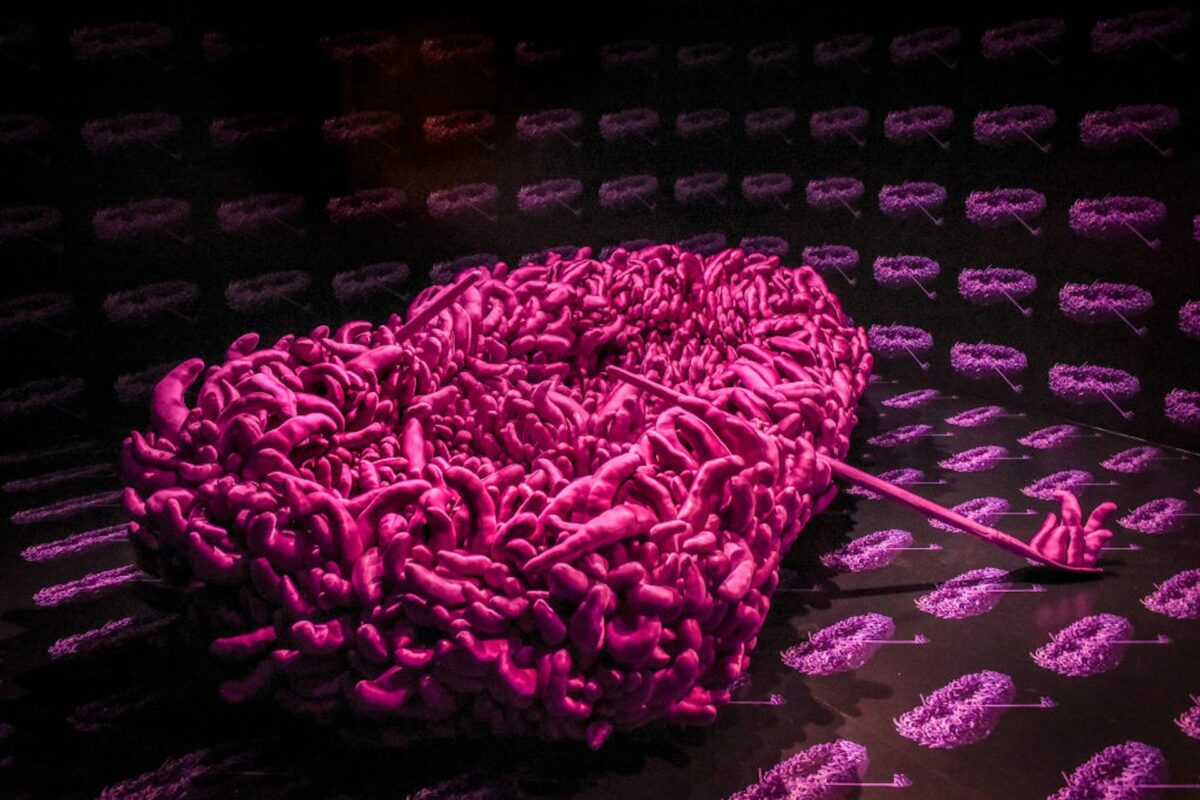
Kusama’s popularity today stems from works that are both visually expansive and socially subversive. Aggregation: One Thousand Boats Show was her first all-over exhibit – an exhibition in which a repeated motif covers the gallery’s four walls, drawing the audience into the work rather than asking them to view it as a separate object. On display at the Gertrude Stein Gallery from December 1963 to January 1964, it featured a sculpture of the phallus-embedded boat surrounded by its image repeating across the wall.
Although Kusama sought to subvert male authority, she appears nude in a photograph of the phallus boat installation, her back to the camera, trapped between the real and the illusory. Rowing the boat seems like the only way to escape the omnipresence of masculinity.
She seemed even more entrapped by patriarchal symbolism in her Infinity Mirror Room — Phalli’s Field, where she lays among an array of phalluses covered in red polka dots.
Psychedelic culture
In 1966, Kusama found a way to break away from male domination through her “Peep Show” at the Castellane Gallery in New York. In it, she reduced the towering phallus to a small dot of light. It was her first work of psychedelic art, a category the curator Christoph Grunenberg characterized as both “artistic experiment and dissenting politics.”
Incorporating Beatles music, flickering strobe lights and mirror reflections, “Peep Show” was intended to produce effects similar to those of psychoactive drugs such as mescaline, psilocybin and LSD, liberating users from established social norms and opening the possibility of alternative values. The exhibit, later known as “Love Forever,” also aimed to alter perception by inducing synesthesia — a neurological state in which stimulating one sensory-cognitive pathway triggers involuntary experiences in another.
Kusama remembered attending a lecture by Timothy Leary, a former Harvard University psychology professor and psychedelics advocate, at the Village Theater in New York, a hub of psychedelic culture. In 1968, she collaborated with light artist Joshua White on Self-Obliteration, a fusion of sound, lights and images that Leary claimed “would demonstrate what an LSD session is like.”
Kusama’s ability to transform any neurosis she may have had into liberation began with Accumulation No. 1 and continued through Fireflies on the Water (2002), Soul Under the Moon (2002), Infinity Mirror Room—Aftermath of Obliteration of Eternity (2009) and Infinity Mirrored Room—The Souls of Millions of Light Years Away (2013). The ethereal visions embodied in her psychedelic mirror rooms stand in for the mind-altering drugs that release people from the rationality of society and fuel the desire to change.
Through Kusama’s Accumulation and Infinity Mirror Room series, I argue that she turned the human body into what philosopher Herbert Marcuse described as “an instrument of pleasure.” By making the body an instrument of pleasure rather than labor, Kusama subverted the age-old patriarchal order.

Midori Yamamura received funding from the Smithsonian American Art Museum's Terra Foundation for her research on Yayoi Kusama.