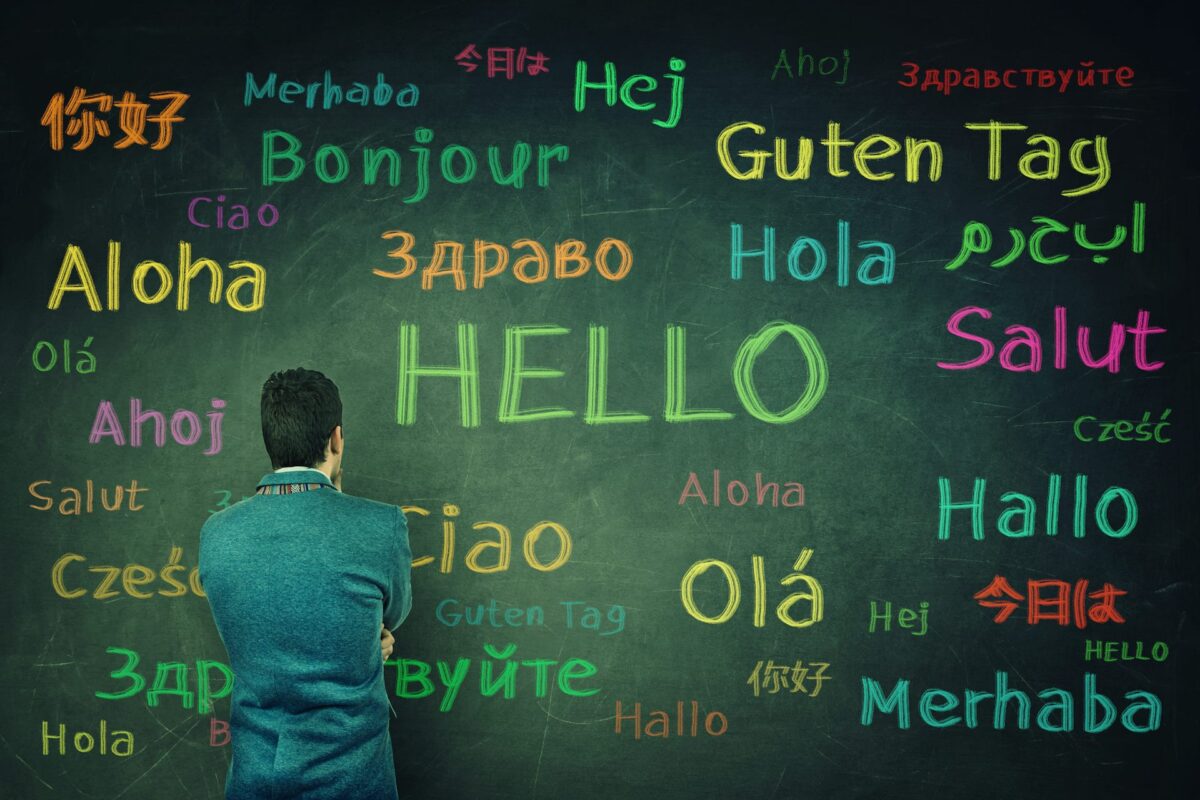
Roughly half of the world’s population speaks more than one language. But speaking two or three languages is very different from claiming proficiency in five, 10 or more.
Throughout history, various people have attracted attention for their remarkable linguistic abilities. Some have genuinely mastered numerous languages, while others have exaggerated their proficiency or struggled to demonstrate their purported abilities.
In my 2026 book “Beyond Words: How We Learn, Use, and Lose Language,” I explore the science of language, including how people acquire, understand and use it, from childhood language development to learning additional languages.
The word polyglot comes from the Greek word polyglōttos, meaning “many-tongued.” It describes someone who speaks multiple languages, but it leaves some important questions unanswered: How many languages must someone know, and how proficient must they be, to earn the title?

SIphotography/iStock/Getty Images Plus
Polyglots throughout time
In the 1998 edition of the “Guinness Book of World Records,” Ziad Youssef Fazah was named the world’s greatest living polyglot. Born in Liberia and raised speaking Arabic, Fazah claimed to speak, read and understand an astonishing 59 languages. At the time, The Washington Post dubbed him the “One-man Tower of Babel.”
He was hardly the first person to attract attention for his supposed extraordinary linguistic abilities.
Cardinal Giuseppe Mezzofanti, an Italian scholar born in 1774, was reportedly proficient in 38 languages.
The 10th-century philosopher Al-Farabi was said to know 70 languages, while the 19th-century German linguist Hans Conon von der Gabelentz was believed to know 80 languages, according to accounts of his linguistic abilities. Sir John Bowring, a British diplomat and governor of Hong Kong, may have known as many as 200 languages.

Universal History Archive/Universal Images Group via Getty Images
Such claims are difficult to verify, particularly when they concern historical figures. What counted as knowing a language? Was it familiarity with its vocabulary and grammar, the ability to read and write it, to translate, or to communicate comfortably with native speakers? These are very different levels of linguistic ability.
Fazah’s abilities were put to the test in 1997 on Chilean television. During a live appearance, he was asked basic questions in several languages, including Russian, Greek and Hindi. He struggled to answer correctly, even when asked relatively simple questions. The performance cast serious doubt on his claims, and his name subsequently disappeared from the “Guinness Book of World Records.”
The episode illustrates a crucial distinction: Knowing some of a language is not the same as being fluent in it.
What does it mean to speak a language?
So, how fluent is fluent?
Fluency in a language is not an all-or-nothing achievement. It is a spectrum, ranging from basic conversational ability to sophisticated, near-native command. Someone might understand a language quite well but struggle to speak it. Another person might hold a conversation comfortably but have difficulty reading or writing. Proficiency can vary across the different ways people understand and use a language.
Linguists generally assess language proficiency across several areas, including speaking, listening, reading and writing. These abilities do not necessarily develop at the same rate. A person who can introduce themselves, order a meal and ask for directions may have a useful working knowledge of a language, but that is not the same as being able to debate politics, understand wordplay or conduct professional business in it.
This makes claims about polyglotism particularly difficult to evaluate. There is no simple threshold that determines when someone can legitimately say they speak a language. And counting languages tells us little without knowing the level of proficiency in each.
A genuine linguistic savant
Not all extraordinary claims are exaggerated.
One remarkable example is Christopher Taylor. A British savant who was born in 1960 and died in 2020, Taylor and his language abilities have long been studied by researchers. Savant syndrome is a rare condition in which someone with a developmental or intellectual disability displays exceptional ability in a particular area, such as music, mathematics or, in Taylor’s case, languages.
Taylor experienced significant developmental delays as a child. As an adult he still required support with everyday activities. Yet he demonstrated an extraordinary capacity for learning languages. He could read, write, translate and converse in 15 to 20 languages, including Danish, Dutch, Finnish, German, Greek, Hindi, Italian, Norwegian, Polish, Portuguese, Russian, Spanish, Swedish, Turkish and Welsh.
His proficiency varied. In some languages he could hold a conversation; in others his understanding was more basic. But his ability to acquire new linguistic knowledge was remarkable. Much of his learning was self-directed, using introductory language books, dictionaries and interactions with native speakers.
In one experiment, published in 1993, Taylor learned the North African language Berber. Researchers found that he quickly grasped aspects of its complex grammar, including patterns of word order and verb agreement. He also mastered an artificial language called Epun, which researchers had invented specifically for the study. This suggested that his abilities extended beyond memorizing familiar words or phrases.
Taylor’s case is extraordinary, but it also offers a useful reminder: Even exceptional language ability comes in degrees. Researchers found that his proficiency varied considerably across languages. He was fluent in some, while in others he had only a basic knowledge. Being able to demonstrate knowledge of a language in a controlled experiment is not necessarily the same as using it fluently in everyday life.
How many languages can someone really learn?
So is it possible to speak 20, 50 or even 100 languages?
Certainly, people can acquire knowledge of many languages, and some exceptional learners can achieve impressive levels of proficiency across several. But the more languages someone says they speak, the more important it becomes to ask what that claim actually means.
Language is more than a collection of vocabulary and grammatical rules. It involves understanding other people, responding spontaneously, interpreting cultural references and adapting to different social situations. A person may memorize thousands of words without being able to sustain a conversation. And proficiency is not necessarily permanent. Languages can become harder to use when they are not regularly practiced, particularly when someone is maintaining several at once.
Polyglots remind us of the remarkable flexibility of the human mind. But their stories also challenge our assumptions about what it means to know a language. Rather than simply counting tongues, we need to look at what people can actually do with them.

Karen Stollznow does not work for, consult, own shares in or receive funding from any company or organization that would benefit from this article, and has disclosed no relevant affiliations beyond their academic appointment.