Over 223,700 children have dropped out of school in Cameroon’s Northwest and Southwest regions, while 2,463 schools are non-operational
Originally published on Global Voices
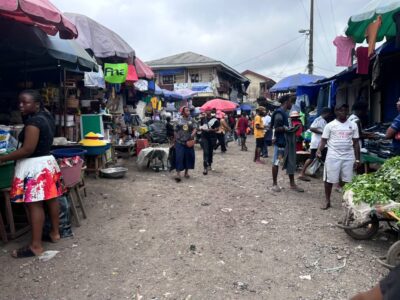
A general view of Buea's OIC Market in the Southwest Region of Cameroon, where displaced families sell goods to support their livelihoods. Photo by Cynthia Ebot Takang. Used with permission.
For children displaced by Cameroon’s ongoing armed Anglophone conflict, reaching safety has not ended the struggle. In Buea, the capital of Cameroon’s Southwest region, some children are balancing school with market trading to help their families survive.
“At least here in Buea, there are no gunshots, and we do not have to hide in the bush,” says 11-year-old Lorane in an interview with Global Voices, describing the relative safety his family found after fleeing their home in Cameroon’s conflict-affected Southwest Region.
The move brought the children to a calmer environment where they could resume schooling and live with less fear of armed violence. But leaving their communities also meant losing homes, familiar surroundings, friendships and, for some, years of education. In Buea, the struggle to rebuild family livelihoods has introduced another responsibility to their lives: helping their parents earn a living.
A safer place, but a childhood reshaped by displacement
The Anglophone crisis in Cameroon began in 2016, when teachers and lawyers began protesting over the perceived marginalization of English-language education and common-law systems, which they say favored French. This escalated into wider demonstrations and a government crackdown. In 2017, the situation deteriorated into armed conflict between government forces and separatist groups seeking independence for the two English-speaking regions as a state commonly referred to as Ambazonia. The United Nations High Commissioner for Refugees (UNHCR) estimates that between 2.1 and 2.2 million people have been displaced due to the violence and insecurity.
At Buea’s OIC Market, children from displaced families sell bleach, puff-puff, plantains, ginger, garlic, and oranges, particularly during weekends and before school. Some travel from neighboring communities to help their parents sell goods, while others work around family-owned stalls.
For 14-year-old Joy, this means traveling from Mutengene to Buea on weekends to sell sachets of bleach. Her mother buys the bleach in bulk and repackages it into smaller sachets, which Joy sells for CFA 100 (about USD 0.17) each. She says daily sales can reach CFA 10,000–15,000 (about USD 16.81–25.21), helping support the household and her siblings.
Joy has been working since her family fled their village when she was in Class Five. “They were shooting guns in my village, so my mum had to bring us here so we could continue school,” she says. She has since become used to the routine, which allows her to contribute to the family while continuing her education.
For 14-year-old Sidoine, displacement meant losing four years of schooling. Her family fled Ekona after their house was burned while they were away at the farm. She remembers hiding in the bushes when they heard attacks were coming, unsure what would happen next. Her family eventually left their hometown, Ekona, for Buea, joining thousands of others who have had to rebuild their lives away from their roots. A well-wisher eventually helped her enroll in school in Buea.
Although the family sometimes visits their farm to collect food, it has not been possible to return permanently. Sidoine misses her former home and friends.
Rebuilding a family livelihood
For younger children, displacement has also changed family routines. Twelve-year-old Michelle sells plantains while waiting for his mother to return from church. His 11-year-old cousin, Lorane, sometimes accompanies him. The two help their parents attract customers, particularly on weekends.
They also miss people they left behind in Ekona, including their grandmother, who died during a raid as a result of the crisis.
Susan Achuagoh, a mother of five whose house was burned during the conflict, has had to rebuild her livelihood as an orange seller in Buea. She gives her children small quantities of oranges to sell while she remains at her stall. This helps supplement their family income.
“I sell oranges; I give them small things to walk around with while I stay at the stall,” she shared in an interview with Global Voices. “If they do not help like that, it will not go at all.”
Her children’s education was interrupted for more than three years during the conflict. Another mother, Mami Blessing, says her children’s schooling was also disrupted and that they now help her at the market as the family struggles to make ends meet.
The cost of conflict
Godiva Ndang epse Limene, Education and Partnerships Officer at Street Child UK-Cameroon, says the prolonged crisis in the Northwest and Southwest has increasingly become a crisis of childhood, affecting education, protection, and development.
Children exposed to armed violence, displacement, and repeated insecurity may experience anxiety, difficulty concentrating, and social withdrawal. Taking on economic responsibilities can add to these pressures. Ndang says work that takes up time needed for learning, rest, and play can affect children’s cognitive, emotional, social, and physical development.
She stresses that helping in a family business is not automatically child labor. The distinction depends on the child’s age, the nature and duration of the activity, the risks involved, and whether it interferes with education, health, rest, or development.
The right to education is only one of the rights affected. Children also have a right to rest, leisure, and play, as well as protection from economic exploitation. For those uprooted from their communities, maintaining friendships, participating in cultural life, and developing a sense of belonging are also important parts of growing up.
Learning spaces offer a route back to education
The scale of the disruption remains significant. Figures from the Regional Delegations of Basic Education cited by UNICEF in September 2026 show that 223,749 children were completely out of school in the Northwest and Southwest, while 2,463 schools were non-operational. Of these, 2,005 were in the Northwest and 458 in the Southwest.
To educate children in conflict-affected communities, local partners including TeenAlive, the Foundation for Inclusive Education (FIED), Strategic Humanitarian Services (SHUMAS), and the Authentique Memorial Empowerment Foundation (AMEF) support Mobile Neighborhood Learning Corners and Satellite Learning Corners. These are established in accessible locations such as village chiefs’ homes, churches, schools, and community verandas.
The program has supported close to 100 learning corners across the two regions. Other education interventions include help with school enrollment, uniforms, and learning materials, as well as Teaching at the Right Level, a tutoring program.
Street Child also combines education with other forms of support. Its girls’ resilience and empowerment work provides displaced adolescent girls with life skills, literacy, and vocational training, alongside start-up kits and mental health assistance. Its Play for Peace initiative, supported by the FIFA Foundation, uses sports to promote peace, health, and education in conflict-affected communities.
Ndang says children also need psychosocial support, safe learning environments, and opportunities to play and interact with their peers. She adds that helping caregivers rebuild their livelihoods matters because reducing economic pressure on families can lessen the burden on children.
Ambition despite displacement
Despite interruptions to their education and the responsibilities they have taken on, the children interviewed for this story continue to speak about their goals and ambitions.
Eliot, 14, who helps his mother sell oranges on weekends, wants to become an engineer. Sidoine hopes to study law, although she worries about the years she lost in school. Vickians, 12, who fled Lebialem and now studies computer science, wants to become a computer engineer.
On weekends, Vickians sells miondo, a cassava-based delicacy, with her parents. Her family continues to make sacrifices to keep her in school, and she remains determined to pursue her education.
At the start of the 2026–2027 academic year, Southwest Governor Bernard Okalia Bilai said the authorities wanted children across the region to have equal access to education and learning facilities, despite differences in school attendance between urban and rural communities. His remarks, reported in this September 2026 interview on the reopening of schools, underline the challenge facing the region: ensuring that displacement and insecurity do not determine whether children can access education.