The ongoing security situation has made the country’s healthcare crisis worse
Originally published on Global Voices
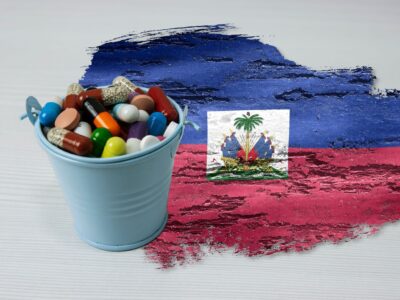
Image by Global Voices, created using Canva elements.
Haiti is a country with very few health facilities and a dearth of healthcare workers to meet people’s needs. Public hospitals lack basic medical equipment, demand far exceeds staff capacity, and administrative problems are rife.
Other health centres, usually run by non-profit organisations, help some of the most vulnerable people, while private hospitals are few and far between, given that most Haitians cannot afford to pay for treatment there. Even the wealthy are often forced to go abroad for treatment when faced with critical health issues.
This already dire situation became worse when gangs from the Viv Ansanm criminal coalition began targeting both public and private health facilities, looting many of them, stealing equipment, and even setting fire to some of the properties. Health centres located in gang-controlled areas are often forced to close temporarily because of fights that break out between rival gangs.
Enter the challenge of street medicine vendors, mobile drugstores, and sellers operating from kiosks. Practically everywhere you go — on sidewalks and public markets, inside bus stations and more — you can find hucksters selling medicine out of buckets and bags, or from small stalls. These vendors have no professional medical training; yet they often “prescribe” drugs that have nothing to do with their customers’ health concerns. Sold in questionable conditions on the street, in heat and dust, these “medicines” pose a serious danger to consumers’ lives.
No Haitian government has fought effectively against this issue. Because most people cannot afford private health centres, they self-medicate, taking these drugs without medical advice. In many cases, the drugs are either expired, spoiled, fake, or do not work as promised. While licensed drug stores are operating, they are small in number compared to the many unauthorised vendors that line the streets.
In a YouTube video on the channel Sedney the Reporter with host Sedney Saint-Fleur, Dr Wellington Derameau, a doctor, pharmacist, and researcher who completed several specialised university training programmes in the United States and France, spoke about the problems in Haiti’s pharmaceutical sector.
That public concern over low-quality medicine led him, in collaboration with the University of Colorado and the Faculty of Medicine at the State University of Haiti, to test the quality of pharmaceuticals circulating across Haiti, particularly in the capital, Port-au-Prince. In 2020, they published the first scientific paper, showing the results of tests in which researchers sampled roughly 258 boxes of antibiotics across 28 open-air markets in Port-au-Prince:
Nou te jwenn 6 antimikwobyen (antibiyotik) sou 11 ki pa t gen okenn konfòmite spèktr. Sa vle di, lòske nou fè des analiz poussées, nou wè ke medikaman sa yo nou te ranmase nan lari a yo pa gen anyen pou wè ak medikaman, pa gen prensip aktif.
We found that six out of 11 antibiotic types failed basic spectral compliance testing. Advanced laboratory analysis revealed that these street-bought products contained no active ingredients whatsoever.
Selling drugs without active compounds in this informal market leaves patients without effective treatment and accelerates antimicrobial resistance. Dr Derameau highlighted cases where patients bought “amoxicillin” expecting a functioning antibiotic, but received capsules filled with starch:
Mache paralèl la fragilize mache legal la, se premye konsta pa m pa rapò ak sa, epi li mete an evidans movèz kalite medikaman yo.
The parallel market undercuts the regulated sector, directly contributing to the spread of substandard medicine.
Official statistics from the Ministry of Public Health and Population (MSPP) for the 2025–2026 fiscal year underline the scope of the problem. Across the nation, only 101 pharmaceutical companies, 49 storage drugstores, 49 import agencies, and three local manufacturing labs hold valid licenses, while some geographic departments lack any legal pharmaceutical representation.
This vacuum, Dr Derameau emphasised, feeds a real threat to public health:
Donc le constat est criant par rapport avec la non-réglementation des pharmacies dans le pays, tout sa pral anjandre nou avèk yon cercle vicieux de vente illicite des médicaments.
The lack of pharmacy regulation creates a glaring threat, trapping the country in a vicious cycle of illicit medicine sales.
Compounded by widespread gang violence and insecurity, these unregulated sales leave the population without reliable access to essential healthcare.
Dr Derameau shared a sad anecdote from his time at Hôpital Universitaire La Paix, involving a child suffering from acute glomerulonephritis. Curious why the patient was not improving, he asked the parents to show him the medicines they were administering. Upon checking, he saw that the medicine was inappropriate for the child’s condition and did not match what had been prescribed. If he hadn’t discovered this in time, it could have led to the child’s death, and nobody would have known the cause because of the absence of forensic facilities in the country:
Mwen pa bezwen di'w ki kantite lòt moun ki viktim, chak desè ta sipoze dokimante pou ale gade koz ki alawouz li malerezman, c'est pas le cas, mwen pran egzanp grenn echantiyon sa donc mwen menm mwen veku, men pa bezwen di'w ki kantite lòt moun ki viktim pa rapò avèk movèz medikaman.
I do not need to tell you how many other people are victims; every death is supposed to be documented to look at the root cause, but unfortunately, that is not the case. I take this single example that I personally experienced, but I do not need to tell you how many other people are victims because of bad medicines.
The child’s parents bought the medicine from a street vendor stationed directly in front of the public hospital, where it is common to find small kiosks and mobile vendors offering different types of medication, and using loudspeakers to advertise all kinds of drugs for various illnesses.
The lion’s share of medication being sold on the Haitian market, Dr Derameau said, comes from India and the Dominican Republic (DR). However, there are also many products with no listed origin at all, which he considers an anomaly. Authorised pharmaceutical laboratories respect quality standards, he explained, as do legitimate importation agencies. The vulnerable area, however, is the border, which serves as the main entry point for contraband.
Although quality control and verification institutions exist alongside the national laboratory as public bodies responsible for regulating the importation, manufacturing, and sale of medicines, this does not stop all kinds of drugs from circulating freely on the market without any real oversight.
Even as he stressed that not all medicines imported from the Dominican Republic are sub-standard, Haiti is flooded with many low-quality drugs, especially when it comes to medications that are in high demand. From his work experience at the Justinien University Hospital in Cap-Haïtien, Dr Derameau also discovered that many of these medicines are not registered with the Ministry of Public Health:
Yo soti nan lòt sirkwit la atravè les fwontyè yo. Gen des laboratwa an Repiblik Dominikèn k ap ponpe nou des medikaman ki pwòp pou Ayiti.
They enter through the other channel across the borders. There are laboratories in the Dominican Republic pumping out medicines made specifically for Haiti.
Noting that generic medicines manufactured by local pharmaceutical laboratories — which number three in total — are very good and respect quality standards, he also posited that there is an industry manufacturing fake medicines within Haiti itself, and called on the state to investigate.
The security crisis is not helping matters. Roads leading to the Great North and Great South — as well as parts of Port-au-Prince — are controlled by various gangs, creating a major obstacle for the free movement of medicine, as well as access to health centres and other distribution points. He highlighted the sabotage and looting that many pharmacies suffered in downtown Port-au-Prince:
Chaîne d'approvisionnement an, insécurité a gen anpil enpak sou li, donk li kraze disponibilité médicaments yo, donc patient vin soufri, marché noir fèt ak médicaments sa yo. Imajine'w tout pharmacie ki te anba lavil la ke bandi yo kase (piye). Gen lòt fenomèn, se machann kap vann nan bus yo kap chanje dat expiration médicaments yo epi y ap vann yo. Donc insécurité a impacté qualité de vie moun yo, insécurité a impacté qualité soins yo, insécurité a impacté protocole thérapeutique yo.
The security crisis heavily impacts the supply chain, thereby destroying medicine availability, causing patients to suffer, and creating a black market for these drugs. Imagine all the pharmacies downtown that bandits looted. There is another phenomenon where vendors selling on buses change the expiration dates on medicines and sell them. So insecurity impacts people’s quality of life, insecurity impacts the quality of care, and insecurity impacts therapeutic protocols.
The challenges around transporting medicines also drive black-market demand and further increase border contraband. Yet Dr Derameau says he is optimistic that if the state shows real political will and enforces strict regulations, it can end these practices.