The school gardens are helping alleviate food insecurity while providing learning opportunities and empower community members
Originally published on Global Voices
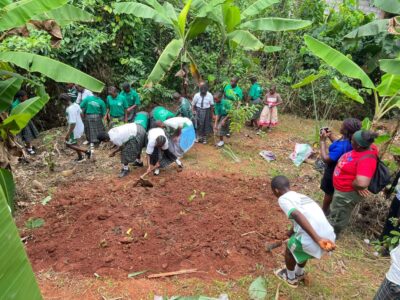
Students of Blessed Bilingual Education Centre preparing the farm. Photo by Support Humanity Cameroon. Used with permission.
Students of Blessed Bilingual Education Centre in Ebang, Cameroon’s Centre Region, have recorded their first harvest of the 2026–2027 school year. Through the Climate Change and Innovation Club, an initiative introduced in 2024 by Support Humanity Cameroon (SUHUCAM) to connect environmental education with practical action, students planted huckleberry in their school garden at the start of the academic year in September. Like them, pupils in Cameroon’s North West Region are managing school gardens and growing food using regenerative practices such as minimal tillage, composting, organic manure and fruit-tree grafting.
Cameroon continues to face a decade-long humanitarian crisis, contributing to food insecurity in the Anglophone regions and Far North, while displacing thousands of families. Earlier this year, the International Federation of Red Cross and Red Crescent Societies reported worsening hunger among nearly 6,000 Cameroonian households following an assessment. More than 3.3 million people were struggling to find enough food, while about 64 percent of households experienced severe food insecurity.
Children are among those affected. Nationwide, 29 percent of children under five experience chronic malnutrition. Beyond its nutritional consequences, food insecurity can also affect children’s ability to learn and participate in school activities.
According to the Food and Agriculture Organisation (FAO), hunger can impair concentration and memory and affect classroom attendance. In February 2026, the organisation reported that only 2.8 percent of primary school pupils in Cameroon received a free hot meal at school, highlighting the limited reach of school lunch programmes.
Conflict, climate-related disasters, agricultural losses and rising staple food prices are among the main drivers of this crisis.
School gardens in action
To combat persistent food insecurity, educators and nonprofit organisations are partnering to teach children how to grow their own food.
In Bamenda, North West region of Cameroon, the Youth Association for Climate Action (YACA) runs the ADAPT Programme, which engages 70 pupils from two nursery and primary schools. Created after a survey revealed that few schools had gardens or provided environmental education, the ADAPT Club has established gardens with five sections: nurseries, vegetables, fruit trees, composting and tubers.
Muluh Kelly Vughose, Programme coordinator for ADAPT, says pupils are involved in more than just planting. “Our volunteers, together with the teachers and pupils, designed each garden. Children are also involved in learning basic agricultural skills like plantain propagation and grafting of fruit trees.” The club holds two sessions each week, lasting about two hours.
In the same region, in Nkambe and neighbouring villages, pupils from six primary and two secondary schools are learning agricultural skills through the Smart School Gardens Project, launched by Youth Development Organisation – Yodo Cameroon. Schools have received wheelbarrows, watering cans and compost manure to support the project.
“During the two years of implementation, I have watched these pupils and students care for plants from seed germination until harvest,” says Ekoaba Cevie, Yodo Cameroon’s Programme Coordinator. The gardens produce cabbage, huckleberry, carrots and Irish potatoes.
Meanwhile, SUHUCAM’s regenerative school garden programme in the Centre region combines fruit trees, including guava, soursop, orange and papaya, with plantains and produce such as huckleberry, cabbage and waterleaf. Through these activities, pupils are learning techniques such as composting, plant propagation and grafting.
Children are embracing the school gardens with enthusiasm, discovering the importance of food production and sustainability through practical experience. Queeninver Ngwangung, SUHUCAM’s Youth and Advocacy Lead, explains:
“Rather than simply teaching students about sustainable agriculture, food security or climate action, we give them opportunities to practice these concepts,” she said. “Through growing food, managing organic waste and caring for their gardens, we have observed that students have learnt that environmental solutions can begin with everyday actions within their own schools.”
For Amang Mael, a Form Three student, seeing vegetables grow on an abandoned plot behind his school has been particularly exciting. “Since we planted the vegetables, I have been so eager to harvest. We add organic manure to all our crops so they can be healthy.”
Another student, Kouba Princesse, believes the garden can contribute to the fight against hunger. “Now that I know how to grow my own vegetables, I will not have to depend on buying from the market all the time,” she says. Some kids have taken the practice home, where they maintain small gardens and use plastic bottles for drip irrigation during the dry season. Other students also say the experience has sparked an interest in pursuing careers in agriculture.
Supporting community nutrition
In 2025, the ADAPT Club produced approximately 45 kilogrammes of dry compost from biodegradable waste. At the end of each planting cycle, YACA organises a Mini School Garden Market Day, where parents and community members can buy the harvest. “Income gained is reinvested in the next planting cycle,” says Muluh Kelly.
At SUHUCAM, the harvests serve nutritional and educational purposes. Students eat fruits from the gardens, while vegetables are sold to purchase seeds and fund their continued management. Some students take extra produce home to establish household gardens.
After two years with two regenerative school garden cycles, SUHUCAM’s Climate Change and Innovation Club has benefitted thousands of households and planted over 400 trees.
In Nkambe, pupils involved in Yodo Cameroon’s project also sell their harvests to community members at affordable prices. The proceeds have helped schools purchase basic educational materials, including chalk and exercise books. Ekoaba Cevie, Yodo Cameroon’s project manager says:
The gardens have become practical outdoor classrooms. Not only are the children learning new agricultural skills, but they are also gaining an appreciation for nature, responsible environmental practices and sustainable resource management.
The nutritional potential of school-based production is also evident in other initiatives. In 2025, an integrated school production programme supported by FAO in Cameroon’s East and South regions established 18 school gardens. The programme produced 236,859 kilogrammes of vegetables, alongside eggs and fish, helping provide weekly healthy meals to 10,833 students. Children, teachers and community members also received training in sustainable agriculture, hygiene and nutrition.
Nkimih Clinton, a researcher at the Institute of Agricultural Research for Development (IRAD), says regenerative practices, such as those deployed in the community gardens, can improve soil health and support sustainable agriculture. Composting, mulching, crop rotation and organic manure, he explains, “can contribute to maintaining the health of pieces of land” for crop production. However, he cautions against expecting small-scale school gardens to eliminate hunger entirely.
Although they may not provide all the food pupils need, they can improve dietary quality by supplying vegetables, legumes and fruits rich in essential vitamins and minerals. “School gardens can be used as a source of production of micro-nutrients to complement basic staples (cassava, maize, rice) provided by parents,” Clinton says.
Challenges to overcome
Despite their benefits, maintaining school gardens remains difficult. Programme coordinators say unpredictable rainfall makes it harder to plan planting activities and sustain crop production. Changing weather conditions can also contribute to pest outbreaks and seed shortages.
Maintaining the gardens during school holidays is another challenge, as pupils are less available to care for the crops. These difficulties can interrupt children’s opportunities to follow the entire production cycle, from planting to harvesting. Expanding the initiatives will therefore require coordinated support from government officials, agricultural research institutions and development partners.
Schools need funding, reliable water supply, farming tools, quality seeds and technical assistance to maintain productive gardens throughout the year.
Government and policy support
Cameroon has previously taken steps to promote environmental education in schools. In 2018, the Ministry of Secondary Education and the Israeli Ambassador to Cameroon launched a Green School campaign that planted 300 trees in 30 schools.
In May 2023, the country launched the second phase of the Classes Vertes project, a three-year initiative developed by FAO in partnership with the Special Council Support Fund for Mutual Assistance (FEICOM) and several government ministries. Targeting 80 schools across the Far North, North, Adamawa, East and South regions, the programme sought to promote vegetable production, fish farming and poultry farming to improve children’s access to nutritious food. It also included tree planting and initiatives to build school canteens, water, sanitation, and hygiene facilities, with an allocated budget of approximately FCFA 722 million (USD 1.2 million).
The government’s commitment to improving children’s access to nutritious food is also reflected in its National School Feeding Strategy for 2025–2030, which aims to expand school meals and strengthen links between schools and local food producers.
Officials hope the program will reach one million learners by 2030. In July 2026, the government, through the Ministry of Basic Education, signed a EUR 3.6 million (USD 4 million) agreement with the World Food Programme (WFP) to expand home-grown school feeding in the Adamawa, East and Far North regions. The 2026–2029 programme is expected to provide nutritious meals to nearly 11,000 children in ten public primary schools while creating market opportunities for 600 smallholder farmers.
Meanwhile, experts believe school gardens can be replicated across Cameroon but stress that their implementation must reflect the country’s different agro-ecological zones. Rather than adopting a uniform approach, schools need solutions suited to their agro-ecological zones.
While school gardens may not independently resolve Cameroon’s food insecurity challenges, they offer opportunities to strengthen children’s nutritional knowledge, promote sustainable agriculture and encourage household food production. Their long-term impact, however, will depend on sustained investment, technical support and policies that enable more schools to establish and maintain these initiatives.