On Nov. 10, 2026, El Salvador President Nayib Bukele posted footage of attack helicopters firing on a compound near Haiti’s capital, Port-au-Prince.
He had earlier requested, via a social media post in Haitian Creole, the address of Wilson Joseph, leader of the 400 Mawozo gang, one of Haiti’s most powerful criminal organizations. Bukele subsequently claimed the operation, conducted with Haitian police, had demolished Joseph’s residence and gang headquarters. As many as 20 people were killed, although Joseph was reportedly absent.
The attack comes amid a flurry of anti-gang operations in Haiti. On Nov. 6, Mathias Saintil, head of the “Boston” gang in Cité Soleil, was killed in a drone strike by a Haitian special task force, prompting Prime Minister Alix Didier Fils-Aimé to declare on the social media platform X “one less gang leader.” Erik Prince, founder of the private military firm Vectus Global, responded: “Nice shot.”
As an expert on organized crime in Latin America and the Caribbean, I believe these operations mark both a dramatic escalation in Haiti’s fight against organized crime and the first overseas test of Bukele’s security model. The intervention is drawing support from some regional leaders and pro-Bukele networks, even as concerns grow over civilian casualties and whether military gains can translate into lasting security.
Rescue mission or military offensive?
El Salvador already had a limited presence in Haiti as one of six countries contributing personnel to the United Nations-backed Gang Suppression Force, or GSF. The force was authorized in 2025 to help Haitian authorities reclaim cities and streets from violent gangs that control swathes of the impoverished nation. But it remains severely understaffed and has struggled to translate military operations into lasting territorial gains.
Then, in an Oct. 18 gang ambush, four Salvadoran aviation technicians attached to the Gang Suppression Force disappeared. Their burned vehicle was recovered, but their fate remains uncertain.
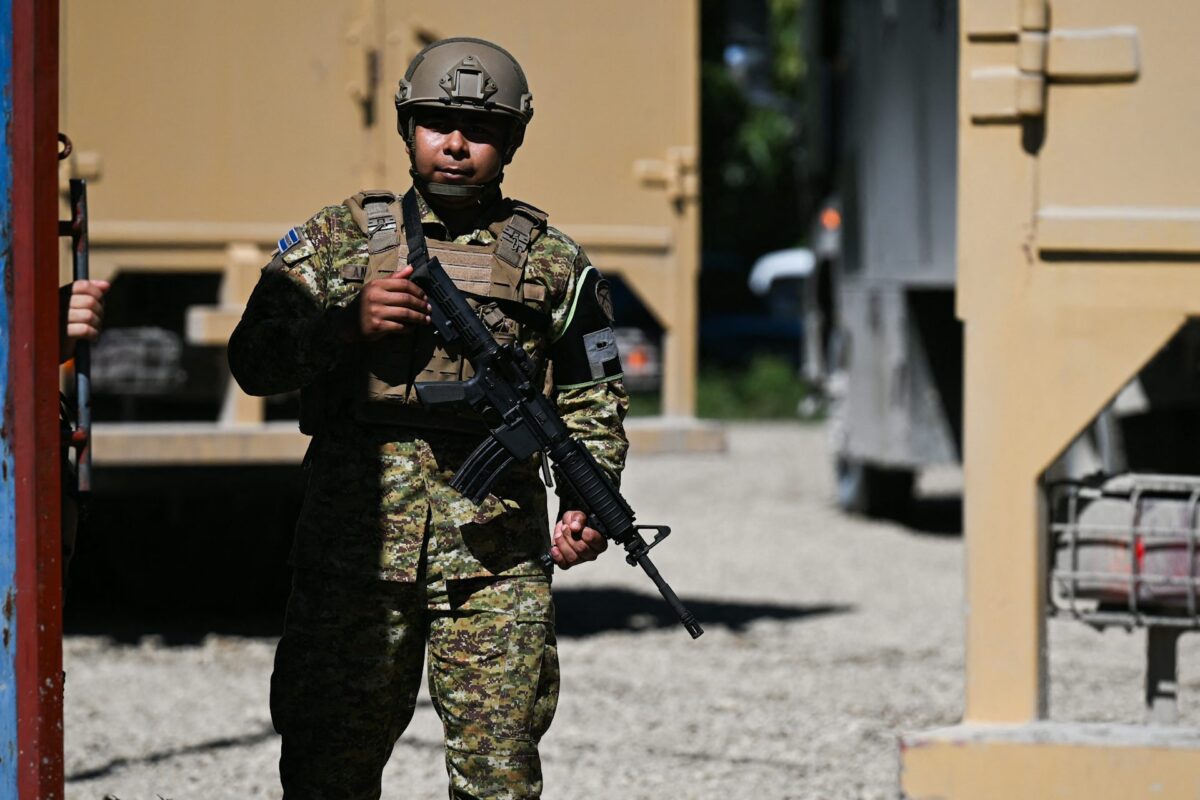
Either way, Bukele used the incident to justify expanding El Salvador’s military presence in Haiti. Within weeks he had sent roughly 2,500 troops, along with armored vehicles and attack helicopters, in what he initially called a rescue mission.
They joined an already crowded battlefield. Haiti’s police and army operate alongside the GSF, authorized but not commanded by the United Nations. The Haitian task force involved in operations against Saintil also works with former Blackwater CEO Prince’s Vectus Global, while vigilante groups patrol contested neighborhoods. Dozens of armed gangs associated with the gang coalition Viv Ansanm control large parts of Port-au-Prince and operate beyond the capital.

Clarens Siffroy/AFP via Getty Images
The Gang Suppression Force was authorized by the U.N. Security Council to deploy up to 5,550 personnel, and it currently has roughly 2,000 on the ground. Most of the Salvadoran troops now in Haiti operate outside its command. Haitian Prime Minister Fils-Aimé insists that Haiti directs the operations. Yet neither government has publicly disclosed the agreement specifying Salvadoran authority, rules of engagement or the deployment’s duration.
Without a published deployment agreement, the chain of command and rules for authorizing strikes remain unclear to the public.
Despite President Donald Trump’s support for Bukele, Secretary of State Marco Rubio has distanced Washington from the Salvadoran offensive, saying the U.S. was “not actively involved.” He warned that poor coordination could lead to friendly fire, while U.S. diplomats formally protested the risks to multinational troops and civilian personnel.
Salvadoran authorities dispute American allegations that their gunfire struck the U.S. embassy and endangered multinational troops. They also questioned the credibility of the top U.S. diplomat in Haiti.
Uncertain rules of engagement
Haiti’s security crisis is dire.
In recent years, organized violence has reached levels associated with armed conflict. Almost 6,000 people were killed in 2025, and more than 4,000 in the first nine months of 2026. Nearly 1.5 million Haitians have been displaced as of August 2026, and expanded offensives and gang reprisals could drive more from their homes.
An independent legal assessment by the Geneva Academy of International Humanitarian Law and Human Rights classifies fighting between Haitian forces and the Viv Ansanm coalition as a noninternational armed conflict, a legal category that includes civil wars. The International Committee of the Red Cross has separately warned of the risks to civilians, urging all sides to respect international law.
The distinction matters because the rules on lethal force are different in war and policing. Both require civilians to be protected. But in an armed conflict, members of armed groups with combat roles can be targeted even when they pose no immediate threat. In a police operation, simply being suspected of gang membership is not enough to justify killing someone – lethal force is generally allowed only when necessary to protect lives.
Of particular concern is the growing use of explosive drones and helicopter attacks in residential areas. At least 1,243 people were killed in 141 drone operations between March 2025 and January 2026, including at least 60 people reportedly unconnected to gangs, 17 of them children. These operations predated the Salvadoran escalation but demonstrate the risks of using explosive weapons in populated areas.
At the same time, overlapping mandates for foreign troops and private military contractors could complicate investigations into civilian casualties and allegations of unlawful attacks.

Clarens Siffroy/AFP via Getty Images
Exporting the Bukele model
Some Haitians, exhausted by insecurity, welcome the international intervention.
Crowds have cheered Salvadoran soldiers, waving sticks and chanting Bukele’s name. A prominent Haitian human rights advocate supported the deployment while warning that residents of gang-controlled neighborhoods are not necessarily gang members.
Bukele promotes the offensive through videos of troops and airstrikes amplified by Salvadoran officials and pro-government influencers. Messages in Haitian Creole and Spanish that portray the strikes as victories against gangs closely resemble the government’s widely circulated footage of mass arrests and prison transfers in El Salvador.
Under Bukele, who came to power in 2019, homicides in El Salvador have plummeted, boosting a belief in parts of South America and the Caribbean that an iron fist approach to gang violence is worth the associated cost to human rights. Indeed, security hardliners across Latin America have pointed to El Salvador’s falling homicide rate to justify similar crackdowns. Dominican President Luis Abinader has endorsed the intervention and confirmed logistical and intelligence cooperation.
Yet the Salvadoran model has relied on emergency powers and mass incarceration. Around 1.7% of Salvadorans are imprisoned – by far the highest rate in the world.
Haiti presents greater operational challenges. According to the U.N. Office for Drugs and Crime, gangs hold extensive territory, possess heavy weapons and maintain connections to political and commercial networks. Haitian institutions are weaker, and children are widely recruited into armed groups from a young age. Sustaining territorial gains would require functioning police and courts, along with protection for residents after foreign troops leave.
The expanded Salvadoran presence in Haiti also carries political risks for both governments. Bukele is seeking a third term in February 2027, following constitutional changes that removed presidential term limits.
Salvadoran military casualties could stir criticism at home and pressure him to escalate, particularly with the four Salvadoran technicians whose disappearance prompted the rescue mission still missing. For his part in Haiti, Fils-Aimé has publicly backed the offensive ahead of Haiti’s elections, scheduled for July and October 2027. Civilian casualties or failure to sustain gains could undermine his own government’s credibility.
Beyond military operations
The deployment may foreshadow wider regional security arrangements.
El Salvador belongs to the U.S.-backed Shield of the Americas, a coalition launched by Trump in March 2026 to expand military cooperation against drug cartels and other transnational criminal groups.
The Salvadoran operation in Haiti does not formally fall under that initiative, whose 15 signatories have pledged closer security cooperation. But such partnerships could allow regional governments to deploy forces with American logistical support while limiting direct U.S. military involvement.
Although the Salvadoran operation is the latest high-profile example, I have seen similar cycles working in Haiti since the 2000s. U.N. peacekeepers and Haitian police cleared parts of Cité Soleil between 2007 and 2009, contributing to a decline in kidnappings but failing to deliver lasting security. The U.N. mission later introduced cholera following the 2010 earthquake, killing more than 9,000 people and prompting an eventual apology from the U.N.
Gangs endure because their economic networks survive military offensives. They profit from kidnappings and illicit trade while controlling access to key roads and markets. Removing leaders can weaken organizations without ending these revenue streams.
While the current Salvadoran offensive may deliver short-term security gains, sustaining them will depend on Haitian institutions maintaining control of recovered territory.
Bukele’s intervention is now an overseas test of a security model with considerable political appeal. But its consequences will ultimately be measured by whether Haitians are safer when foreign forces depart.

Robert Muggah is the co-founder of the Igarapé Institute, and a principal of the SecDev Group. He also advises governments, private companies, non-profits and international organizations such as the United Nations, the IMF and the World Bank.